



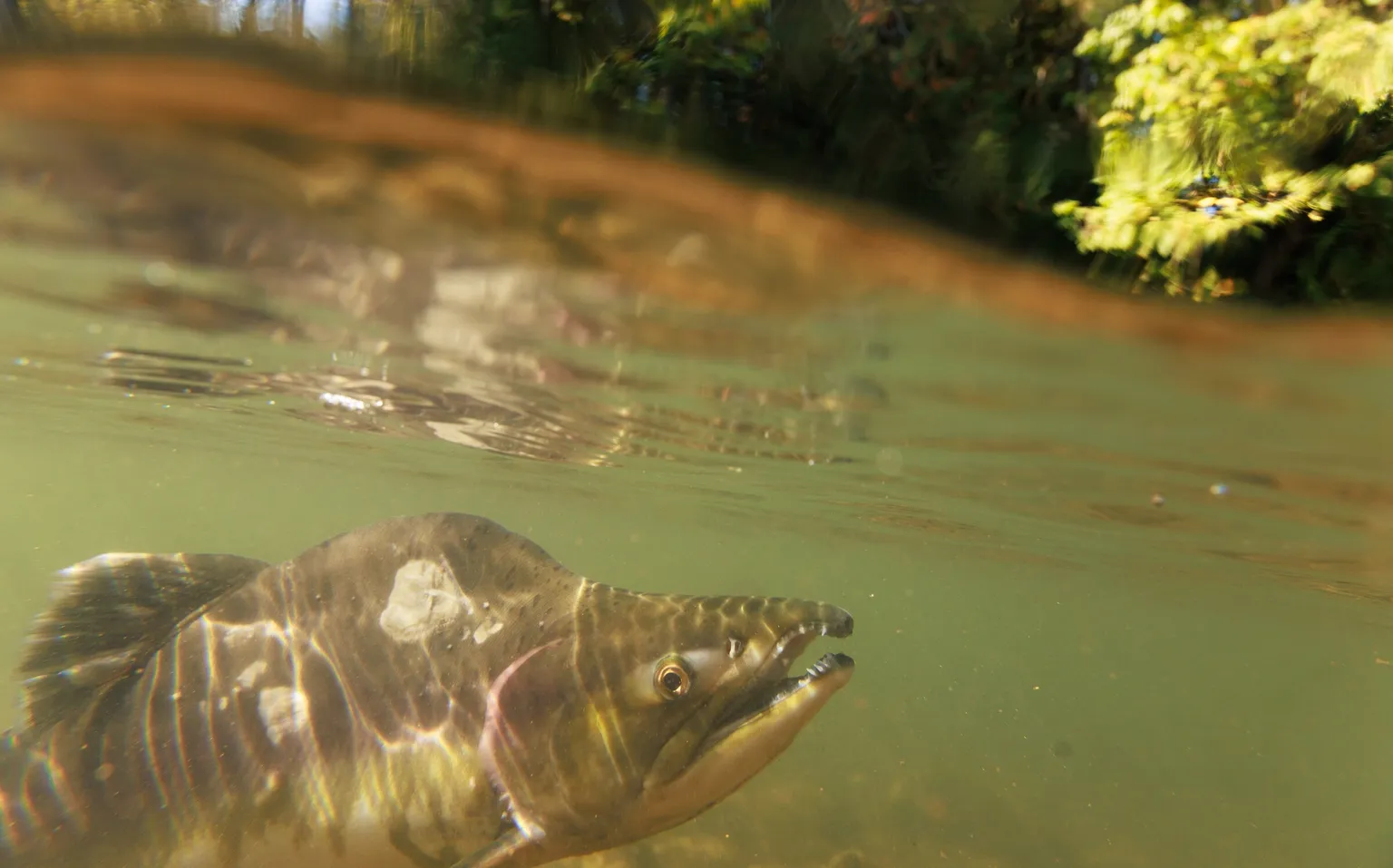
A male pink salmon — the species is sometimes referred to as humpback salmon — swims in the Green River at Flaming Geyser State Park in southwest King County last fall. (Erika Schultz / The Seattle Times)
March 15, 2026 at 6:00 am Updated March 15, 2026 at 6:01 am
Seattle Times staff reporter

Climate Lab is a Seattle Times initiative that explores the effects of climate change in the Pacific Northwest and beyond. The project is funded in part by The Bullitt Foundation, CO2 Foundation, Jim and Birte Falconer, Mike and Becky Hughes, Henry M. Jackson Foundation, Martin-Fabert Foundation, Craig McKibben and Sarah Merner, Mary Snapp and Spencer Frazer, University of Washington and Walker Family Foundation, and its fiscal sponsor is the Seattle Foundation.
GREEN RIVER, Flaming Geyser State Park — The future is pink.
Their tails thrashed in a crescendo through the riffles, humps piercing the water’s surface. Thousands of pink salmon had reached the final leg of their high-seas journey last fall.
They would soon spawn the next generation and join others decomposing along the shore, their bodies’ nutrients feeding the emerald canopy above.
This display of abundance is rare, reminiscent of stories passed down describing salmon running so thick in Pacific Northwest rivers that one could walk across their backs. It also illustrates how climate change has disrupted the world’s natural rhythms.
Pink salmon, the smallest Pacific salmon, are among the world’s so-called climate winners. They appear to largely bypass the worst effects of habitat loss, superheated streams and low flows. And they potentially benefit from ocean heating — so far.
Compared with Chinook, pink salmon are climate winners
Scientists like Greg Ruggerone say that pinks have benefited from climate change. Their small size and 2-year life cycle have allowed them to bypass the worst effects, such as marine heatwaves. Their brief residence in freshwater and estuaries mean they’re less likely to encounter dams, degraded habitat or overheated streams.
Anatomy and life cycle of pink salmon versus Chinook (Illustration by Fiona Martin / The Seattle Times).. Caption: Anatomy and life cycle of pink salmon versus Chinook. Sources: Greg Ruggerone, Field Guide to Coastal Fishes, field surveys (Illustration by Fiona Martin / The Seattle Times).
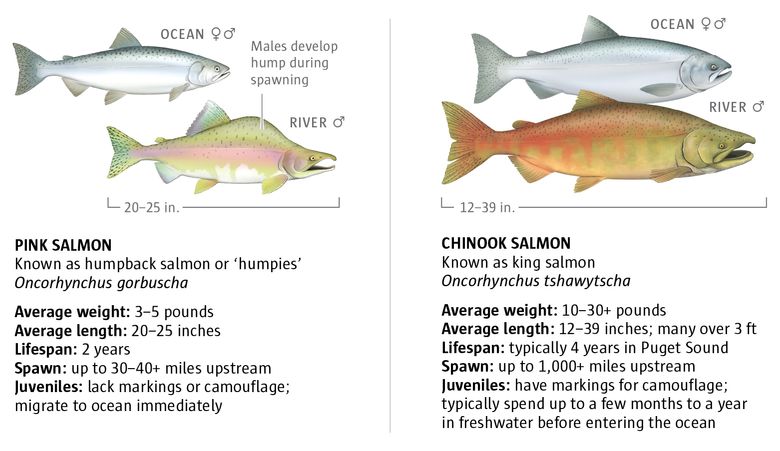
Field surveys, Greg Ruggerone, Field Guide to Coastal Fishes, NOAA (Illustration by Fiona Martin / The Seattle Times)
Pacific salmon species
• Chinook (or king)
• Sockeye
• Coho (silver)
• Chum (dog salmon)
• Pink (humpback salmon or humpies)
Since the mid-1970s, pinks have become the dominant species of Pacific salmon, representing nearly 80% of all adult salmon returning to North Pacific rivers to spawn in 2021 and 2023. They have a fixed, two-year life cycle, and their odd-year abundance has revealed itself in a biennial pattern, visible in everything ranging from plankton to the southern resident orcas, recent research shows.
The pinks’ success has been linked to additional pressure on other salmon already struggling against strong headwinds. The pinks, while fun to catch, are no substitute for economically and culturally important salmon like Chinook, a species most prized in Northwest waters for its size and nutritional benefits to people, orcas and the broader ecosystem that depends on them.
Pink salmon boom
WATCH: Nathanael Overman, a state fisheries biologist, explains a strong relationship between a boom in pink salmon and the death of Chinook before they can spawn the next generation.
(Isabella Breda and Erika Schultz / The Seattle Times)
Humans have tipped the scale. Climate change is scrambling food webs, and pink salmon hatcheries (about 1 billion pinks annually from Alaska alone) are inflating the number of mouths to feed in the ocean.
Scientists like Greg Ruggerone, an international salmon expert, have begun to demonstrate that the ocean’s resources aren’t unlimited.
Fisheries managers from Native nations, West Coast states and the federal government are convening this month to exchange notes and establish harvest quotas intended to balance conservation, cultural and economic needs. States and tribes will take this information to establish their local fisheries.
To be sure, 2026 will see very few pinks. But pink salmon have been a more frequent topic of conversation among fisheries managers.
When young Puget Sound salmon head north to feed and grow in their ocean adulthood, they face myriad threats. Throughout their ocean life they may encounter marine heat waves made more frequent by global warming. They also face hungry seals, sea lions and orcas, and fishing gear.
And now they contend with millions of pink salmon trying to navigate the same gantlet.
Pink salmon are booming in the North Pacific
Since the mid 1970s, pinks have become the dominant species of Pacific salmon, representing nearly 80% of all adult salmon that returned to North Pacific rivers to spawn in 2021 and 2023.
Source: Ruggerone and Irvine 2018, updated Oct. 2025 (Chart by Fiona Martin / The Seattle Times)
The Northwest’s salmon story is mixed.
The Duwamish, Seattle’s only river, has seen a world of change.
The White, Green, Cedar and Black rivers used to run together. In attempts to tame flooding and transform tidelands to a massive commerce hub, European settlers rerouted the rivers and dried up the Black.
Today, miles of spawning habitat on the Green are locked behind a flood-control dam. The Green becomes the Duwamish in Tukwila and turns into a working waterway and environmental cleanup site as it flows through the Port of Seattle.
The Muckleshoot Indian Tribe has had some success restoring salmon to this place, through careful intervention. The Duwamish River has in recent years seen a harvestable, recovering return of chum, coho and fall Chinook.
Yet extinction has come for many salmon runs here and is looming for others. Lake Washington sockeye have to be trucked around bathlike water that otherwise wipes out more than two-thirds of the returning adults before they can reach the spawning grounds.
But the pinks? They’re booming.
“With all the warm water, everything that’s happening, even without the help of a hatchery, there are millions of them,” said Muckleshoot Fish Commission Chair Leeroy Courville Jr.
Pink salmon fry, lacking any markings for camouflage, migrate to saltwater immediately (Illustration by Fiona Martin / The Seattle Times).. Caption: Pink salmon fry, lacking any markings for camouflage, migrate to saltwater immediately. Sources: Greg Ruggerone, Eiko Jones, NOAA (Illustration by Fiona Martin / The Seattle Times).
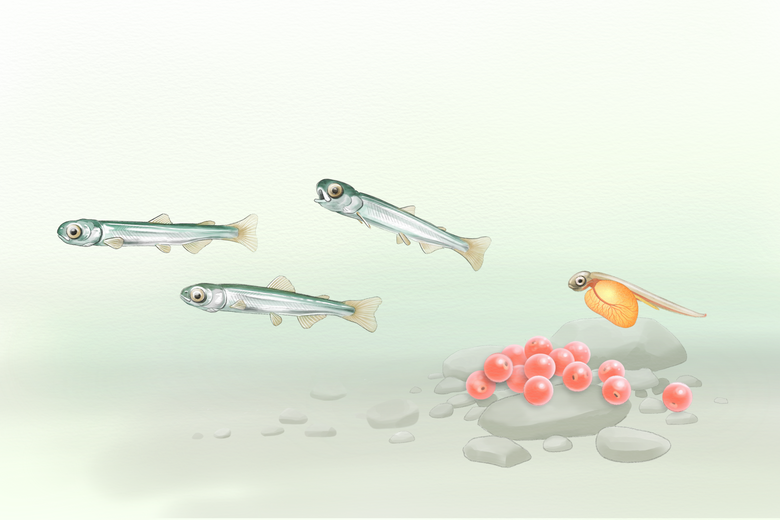
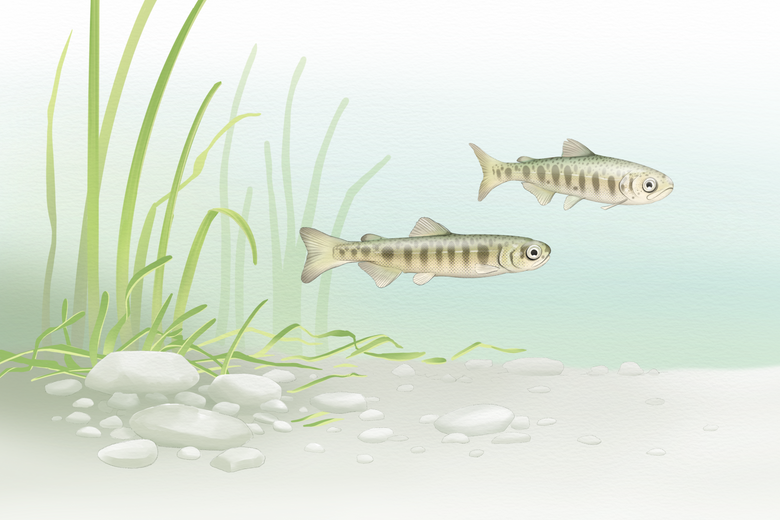
1 of 2 | Pink salmon fry, lacking any markings for camouflage, migrate to saltwater immediately. Sources: Greg Ruggerone, Eiko Jones, NOAA (Illustration by Fiona Martin / The Seattle Times).
Climate winners
On the Green River, a female pink turned on her side, flashing her white belly as she beat her tail into the cobbles, kicking up a cloud of silt. She was clearing the path for her egg nest.
Soon, a snaggletoothed male would jockey for a shot to spawn alongside her. This dance would be replicated thousands of times across Puget Sound where millions of pink salmon, also called humpies (a moniker familiar to fans of one of the Mariners’ most celebrated mascots), returned last fall.
The pink’s unique life cycle, compared with other salmon, may have allowed them to thrive.
Juvenile coho, Chinook and steelhead — after emerging from the gravels of Northwest rivers — spend months or more growing in the freshwater, relying on dark, cool logjams and nutrient-rich estuaries. They face some of the worst effects of habitat degradation.
Summer steelhead may experience superheated rivers and streams as they attempt to return to spawn several times over.
Young coho and Chinook rely upon estuary habitat to grow strong before heading to the ocean. More than half of estuary habitat across Puget Sound has been lost to parking lots, strip malls, farms and shipping ports.
But pink salmon jet out to the saltwater within days of leaving their nest.
In the ocean, marine heat waves are becoming more frequent, jumbling food webs. Yet pinks appear to benefit from ocean warming across their range in the North Pacific.
Scientists have found pink abundance increased after warmer years at sea. These warmer waters, coupled with the increased number of pinks, reduce available food, making it harder for larger salmon, which typically spend up to five years at sea, to get enough to eat.
Pink salmon abundance upends ocean food webs — from plankton to southern resident orcas
Pinks have a fixed, two-year life cycle, and their odd-year abundance has revealed itself in a biennial pattern, visible in everything ranging from plankton to the southern resident orcas, recent research shows.
In the North Pacific, large aggregations of pink salmon depend on zooplankton for food— tiny, microscopic animals that are at the base of the consumer food chain. Heavy grazing by pinks on this food source in odd years can trigger a trophic cascade, affecting species both above and below them in the food web. As pink salmon rapidly grow in their second season at sea, they shift to larger prey, including squid and small fishes—competing for the same food relied upon by Chinook, coho and steelhead, which are prey for southern resident orcas. With fewer zooplankton to keep them in check in odd years, phytoplankton blooms can become more common. Southern resident orcas prefer Chinook over pink salmon for their larger body size and fat content. But since the 1990s, in odd years, pinks outnumber Chinook 100 to 1 in Puget Sound rivers and 50 to 1 in the Salish Sea. Scientists hypothesize that this makes echolocation difficult. Few pinks return in even years (Illustrations by Fiona Martin / The Seattle Times).. Caption: In the North Pacific, large aggregations of pink salmon depend on zooplankton for food— tiny, microscopic animals that are at the base of the consumer food chain. Heavy grazing by pinks on this food source in odd years can trigger a trophic cascade, affecting species both above and below them in the food web. As pink salmon rapidly grow in their second season at sea, they shift to larger prey, including squid and small fishes—competing for the same food relied upon by Chinook, coho and steelhead, which are prey for southern resident orcas. With fewer zooplankton to keep them in check in odd years, phytoplankton blooms can become more common. Southern resident orcas prefer Chinook over pink salmon for their larger body size and fat content. But since the 1990s, in odd years, pinks outnumber Chinook 100 to 1 in Puget Sound rivers and 50 to 1 in the Salish Sea. Scientists hypothesize that this makes echolocation difficult. Few pinks return in even years. Sources: Greg Ruggerone, Field Guide to Coastal Fishes, NOAA, Washington Department of Fish and Wildlife, field surveys (Illustrations by Fiona Martin / The Seattle Times).
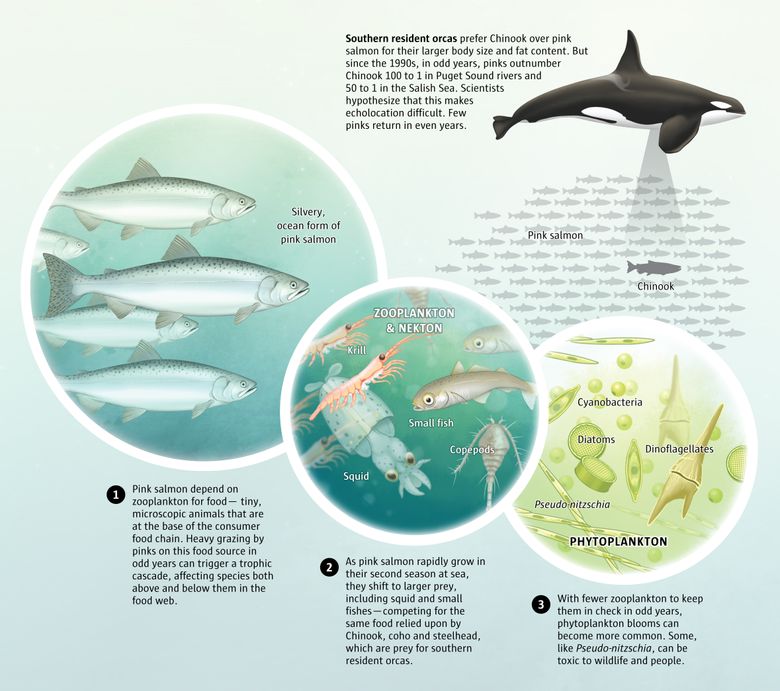
Sources: Greg Ruggerone, field surveys, NOAA (Illustrations by Fiona Martin / The Seattle Times)
The pinks only spend one winter in the ocean.
While at sea, they gorge themselves on zooplankton, then squid and small fishes. They grow rapidly.
Pinks even outcompete the other salmon that often rely on the same ocean food. Research has shown that pinks have more food in their stomachs than other salmon. In odd years, when pinks are especially abundant, the stomach contents of Chinook, sockeye, steelhead and coho often decline, research shows.
So far, pink salmon have benefited from climate change and ocean warming and have been less affected than other salmon and steelhead by changes in freshwater habitat, said Ruggerone, a leading pink salmon researcher.
Scientific technician Dan Estell collects data on female Chinook that died before spawning at Flaming Geyser State Park. Surveys led by the Muckleshoot Tribe and the state Department of Fish and Wildlife tally live pink salmon and Chinook nests, called redds. The counts help estimate how many adult Chinook are likely to return to spawn each autumn. (Erika Schultz / The Seattle Times)
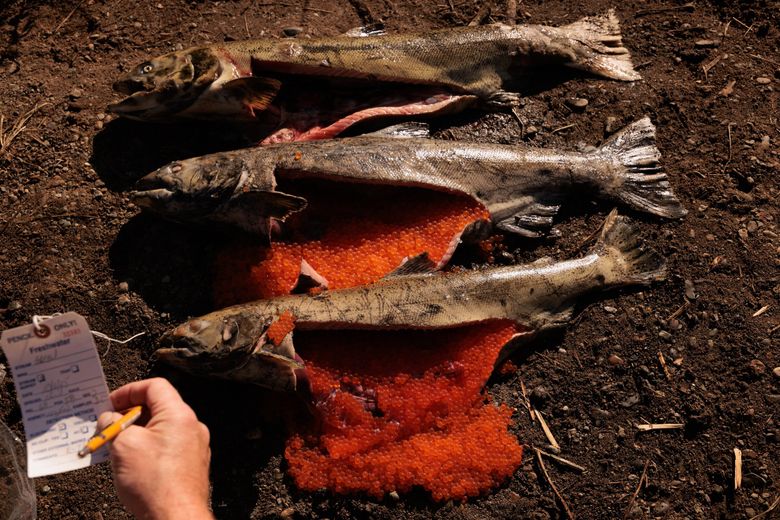
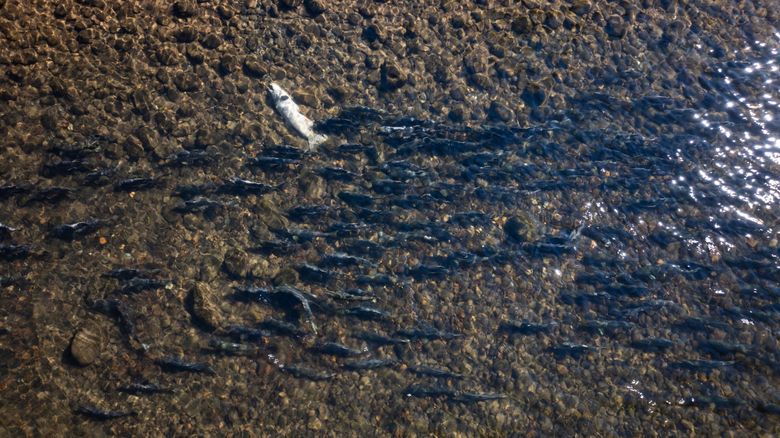
1 of 2 | Scientific technician Dan Estell collects data on female Chinook that died before spawning at Flaming Geyser State Park. Surveys led by the Muckleshoot Tribe and the state Department of Fish and Wildlife tally live pink salmon and Chinook nests, called… (Erika Schultz / The Seattle Times)More
At a cost
The biologists rounded the eddy toward the shore of Flaming Geyser State Park on a drizzly late September morning.
Nathanael Overman, a state fish biologist, waited on the beach, scribbling down notes as the biologists from the state and Muckleshoot Tribe called out their tallies: 12 Chinook redds, or nests, and 6,500 live pink salmon.
On one survey this fall, Dan Estell, a scientific technician with the state, sliced a Chinook carcass open and ruby red pearls — her eggs — spilled onto the sand. The biologists collect information from carcasses, including checking for eggs to see if Chinook died before spawning.
On the Green River are, from left, Jesse Nitz, fisheries biologist at Muckleshoot Indian Tribe, and state Fish and Wildlife scientific technicians Dave Smith and Dan Estell. (Erika Schultz / The Seattle Times)
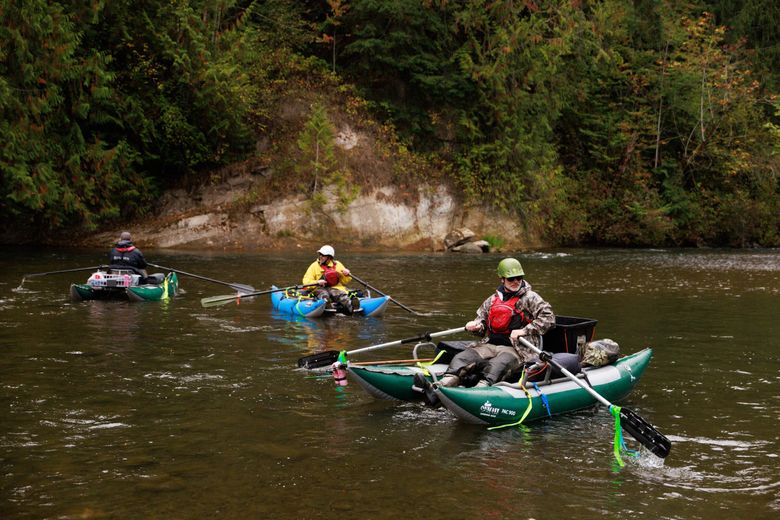
On the Green River are, from left, Jesse Nitz, fisheries biologist at Muckleshoot Indian Tribe, and state Fish and Wildlife scientific technicians Dave Smith and Dan Estell. (Erika Schultz / The Seattle Times)
This is a more typical scene when pinks are running, Overman explained.
Few pink salmon spawned in the Green River before the early 2000s.
Within a decade, there were over a million.
“That was one of those first real wake-up calls: What is going on?” said Jason Schaffler, Muckleshoot Tribe’s fisheries director. The runs dipped back down after a few years of poorer ocean conditions. Then they surged.
“We finally started getting the data that 2009, 2011, they weren’t just aberrations,” Schaffler said.
Pink salmon returns in Puget Sound
The spiked appearance of this chart is no accident. Pink salmon return en masse in odd years, migrating about 30 miles upstream from estuaries to spawn. In even years, returns are almost zero.
Sources: Pacific Fishery Management Council, Greg Ruggerone (Chart by Fiona Martin / The Seattle Times)
These Green River Chinook face environmental stressors such as low flows, predators and warm water — and they are cut off from their upper river habitat. On the remaining spawning grounds, competing with pinks for space may add another level of stress.
The state and Muckleshoot Tribe have observed a correlation between the number of pink salmon on the spawning grounds and the percentage of female Chinook that die before spawning.
There’s prespawn mortality every year in the Green, Schaffler said, but in pink years, it appears to be much higher. And 2025 included the highest prespawn mortality biologists have seen, he said.
In the Green River in 2025, more than 40% of hatchery and wild female Chinook died before spawning.
Each year, scientists sampled hundreds of Chinook carcasses in the Green River to see whether females had spawned successfully, or still had eggs in their bellies. They found Chinook pre-spawn mortality was higher in odd years than in even years.
Source: Nathanael Overman, Washington Department of Fish and Wildlife (Chart by Fiona Martin, Ava Mandoli / The Seattle Times)
Ruggerone’s research has also tracked significantly lower numbers of Chinook spawning in Puget Sound rivers when adult pink salmon are running.
This biennial pattern began to show up in the late 1990s — with 39% fewer Chinook on average returning to Puget Sound rivers to spawn in pink salmon years. Odd-year pink salmon returns to Puget Sound spawning grounds have tripled since the period before 1997.
Researchers have seen signals of pinks across the Pacific food web.
Reading sockeye scales under a microscope like tree rings, scientists first saw years of stunted marine growth in other salmon that coincided with pink salmon abundance.
Another signal was visible in the copepods that form the base of the food web in the Bering Sea and central North Pacific. It appeared in the growth of forage fish, like herring, and other prey salmon rely on.
Signals too appeared in Washington coastal chum salmon returns, which are on average 23% lower in pink years. This likely reflects competition between pinks and Washington coastal chum in the Gulf of Alaska because essentially no pink salmon return to spawn along the Washington coast, Ruggerone said.
Dan Estell, scientific technician for the state Department of Fish and Wildlife, collects scale samples on Chinook salmon on the Green River last September. At the laboratory, the scales will be read under a microscope like tree rings. Sockeye scales have shown years of stunted growth that coincided with pink salmon abundance. (Erika Schultz / The Seattle Times)
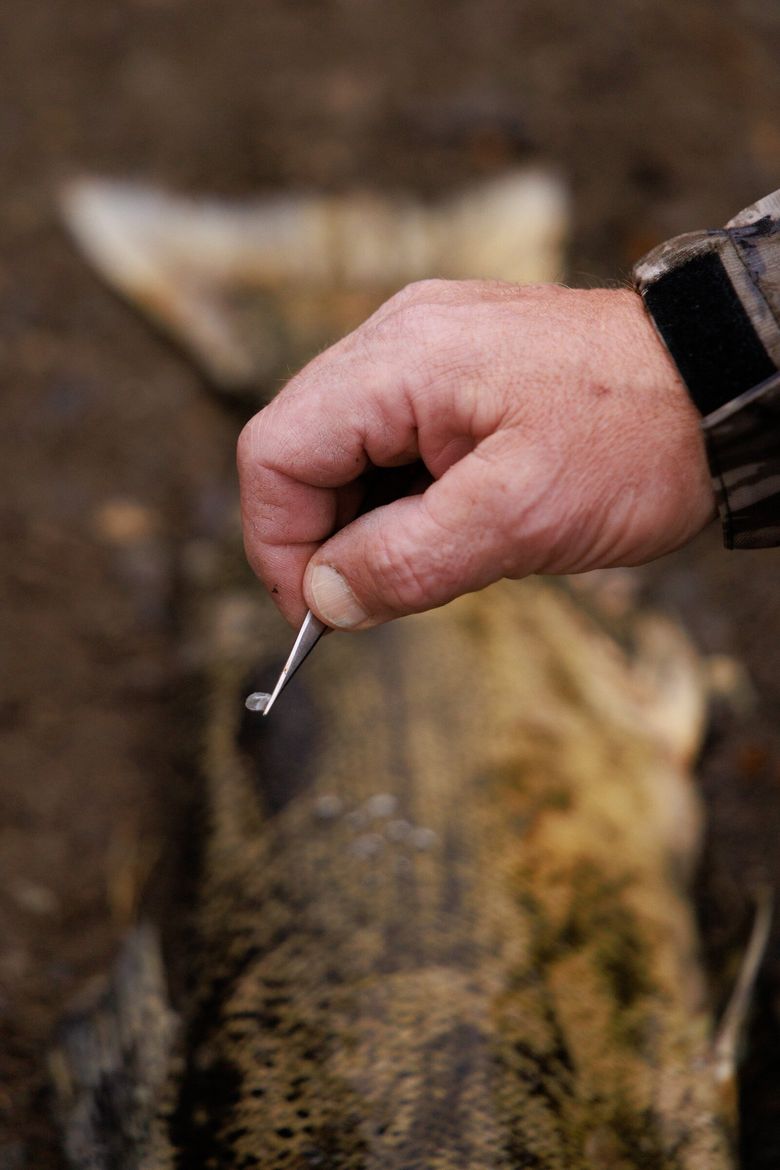
Dan Estell, scientific technician for the state Department of Fish and Wildlife, collects scale samples on Chinook salmon on the Green River last… (Erika Schultz / The Seattle Times)More
And the decline of the endangered southern resident killer whales has too moved in a biennial sequence. Their deaths were 3.6 times higher and births 50% lower after pink years, in a study analyzing data from 1998 to 2017.
More recent evidence showed the southern resident’s L pod was in poorer health in the fall of pink years, probably because of reduced Chinook abundance.
The southern resident orcas co-evolved with Chinook salmon, finding and foraging on fish that were the most lipid-rich, said Deborah Giles, a killer whale scientist with the SeaDoc Society. Chinook offer a better reward for their effort.
Pinks have never been found in the orcas’ poop. The abundance of pinks may make it harder for the orcas to echolocate and catch their preferred food.
Muckleshoot fisher Tyson Simmons, aboard his bowpicker boat The Shaker, caught 40-50 coho salmon on this sunny September day on Elliott Bay. (Ellen M. Banner / The Seattle Times)
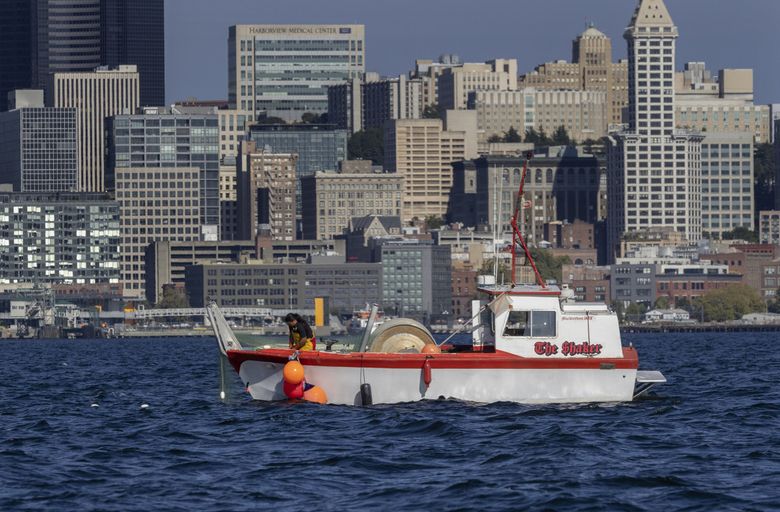
Muckleshoot fisher Tyson Simmons, aboard his bowpicker boat The Shaker, caught 40-50 coho salmon on this sunny September day on Elliott Bay. (Ellen M. Banner / The Seattle Times)
A future
On Elliott Bay just before dusk this fall, a shimmering coho thrashed in Tyson Simmons’ soft green net.
“Finally, a fish,” Simmons, a member of the Muckleshoot Tribe, shouted over the groan of his motor, swiftly combing through the folds of his net and breaking the salmon free.
Fisheries here have been inconsistent for many who rely on these harvests to feed their families, sustain their culture and fill their spirits. The most recent Chinook fishery closed early to ensure enough of the threatened fish would make it to spawning grounds.
In the late 2000s, fewer than 300 natural Chinook returned to spawn in the Green River.
Tyson Simmons, aboard his bowpicker boat The Shaker, admires some of the coho salmon caught on Elliott Bay in September. (Ellen M. Banner / The Seattle Times)
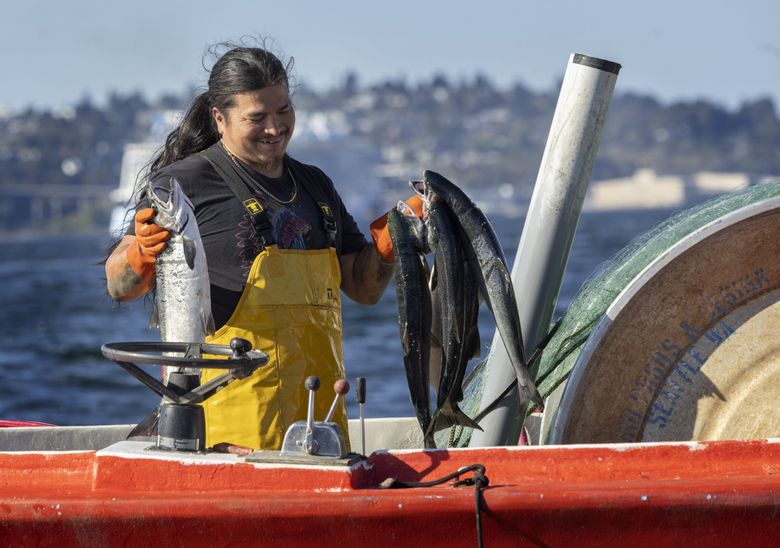
Tyson Simmons, aboard his bowpicker boat The Shaker, admires some of the coho salmon caught on Elliott Bay in September. (Ellen M. Banner / The Seattle Times)
The Muckleshoot Tribe has intervened to recover the run. One program included rearing juvenile Chinook at a hatchery, safeguarding them from predators and poor habitat in the river, to give them a better shot of ocean survival. The tribe has also moved Chinook that returned to the hatchery out to the river to spawn naturally.
After years of conservation closures to fisheries in Elliott Bay and on the river, a harvestable run began to return. The number of wild spawners went from hundreds to thousands.
The numbers looked especially promising in recent years.
Together, the state’s Soos Creek Hatchery and the tribe’s Keta Creek Hatchery have helped to stabilize and provide harvestable runs of chum, coho and Chinook enjoyed by subsistence, commercial and recreational fishers.
Schaffler points out that the first hatchery on the Green River was built 125 years ago. He says that was an acknowledgment of actions by European settlers — taking habitat and filling newly built canneries — that were detrimental to Chinook.
In the Green River, a male pink salmon returns to his home waters at the end of his life. The characteristic hump, which only spawning males have, earned the species the “humpback” name. (Erika Schultz / The Seattle Times)
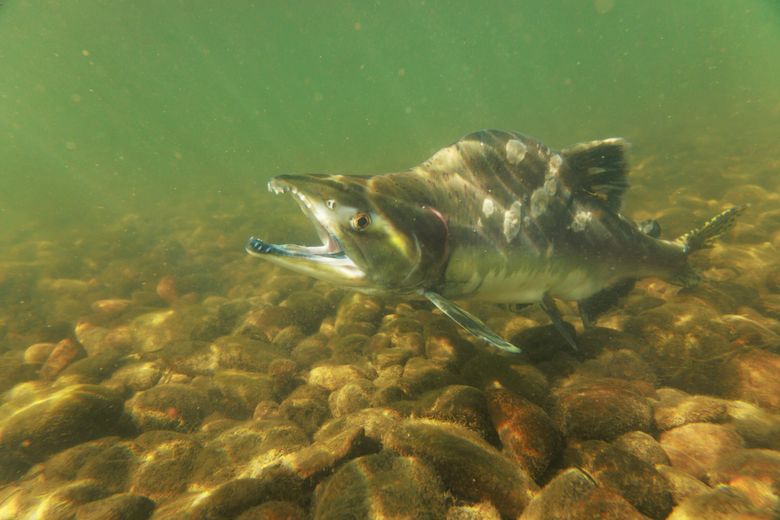
In the Green River, a male pink salmon returns to his home waters at the end of his life. The characteristic hump, which only spawning males have, earned the species the “humpback” name. (Erika Schultz / The Seattle Times)
Now the climate is changing: Streams are warming, we’re getting less snowpack, Schaffler said. Humans have logged and removed big wood from Puget Sound rivers, he continued, and flood plains have been reduced to narrow river channels to clear the way for development.
If the habitat existed, Schaffler hypothesizes Chinook could outcompete pinks.
We can continue down a path of damage and extinction, or we can take this information and innovate solutions to ensure the orcas, people and land are fed, said Valerie Segrest, a Native foods educator and Muckleshoot tribal member.
Centering Indigenous expertise and knowledge, she said, is a first step.
Muckleshoot fisher and Councilmember Louie Ungaro looks out at the Greenwater River, which has some of the last seasonal spawning channels for coho, spring and fall Chinook, steelhead and pink salmon. (Erika Schultz / The Seattle Times)
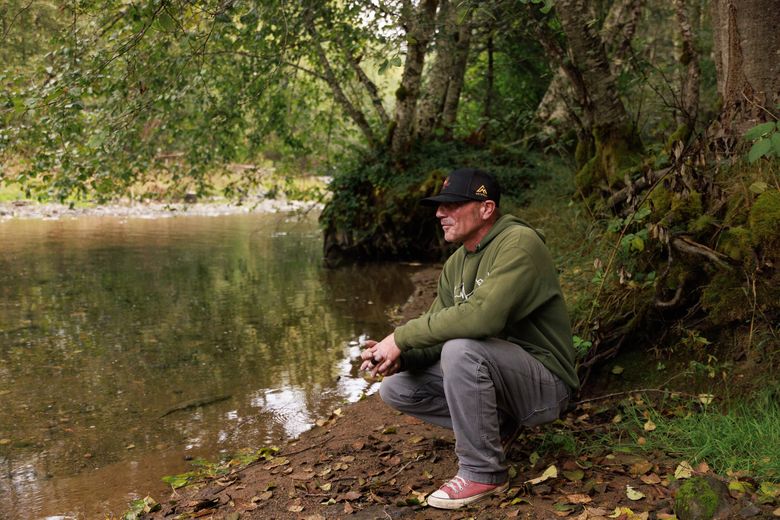
Muckleshoot fisher and Councilmember Louie Ungaro looks out at the Greenwater River, which has some of the last seasonal spawning channels for coho, spring and fall Chinook, steelhead and pink… (Erika Schultz / The Seattle Times)More
Muckleshoot fisher and Councilmember Louie Ungaro said he hopes to see further habitat restoration and other protections in place for the Puget Sound salmon, like the imperiled Chinook, throughout their migration routes from the freshwater to the Alaskan coast and back.
The abundance of these wild pinks in Puget Sound, Ungaro said, is a gift. He cautioned about scapegoating the species for damage done by human hands.
But, he said, pinks need to be managed so other species can thrive.
“We try to fight for what’s given us life for over 10,000 years,” Ungaro said. “We have to pay attention to what they’re telling us.”
Isabella Breda: 206-652-6536 or ibreda@seattletimes.com. Isabella Breda is a reporter with The Seattle Times’ Climate Lab.