


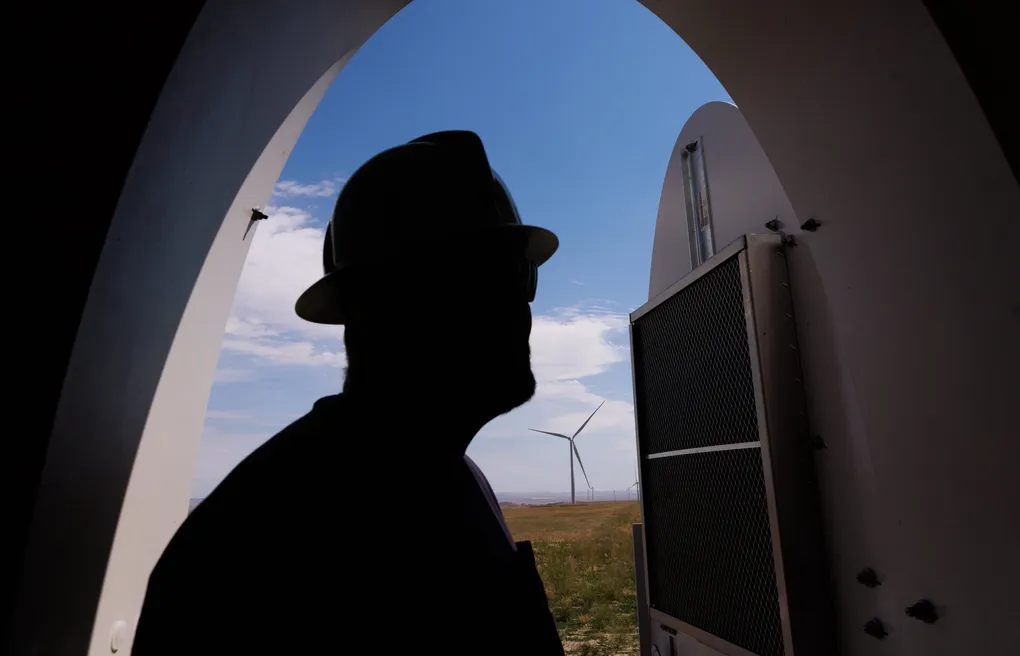
Kyle Sullivan, now the plant manager at the Beaver Creek wind farm in Stillwater County, Mont., stands within the base of a wind turbine last summer. The 248-megawatt project, owned by Puget Sound Energy, came online in August and cost the utility $530 million. (Erika Schultz / The Seattle Times)
Kyle Sullivan, now the plant manager at the Beaver Creek wind farm in Stillwater County, Mont., stands within the base of a wind turbine last summer. The 248-megawatt project, owned by Puget Sound Energy, came online in August and cost the utility $530 million. (Erika Schultz / The Seattle Times)
By
Amanda Zhou
Seattle Times climate reporter

Climate Lab is a Seattle Times initiative that explores the effects of climate change in the Pacific Northwest and beyond. The project is funded in part by The Bullitt Foundation, CO2 Foundation, Jim and Birte Falconer, Mike and Becky Hughes, Henry M. Jackson Foundation, Martin-Fabert Foundation, Craig McKibben and Sarah Merner, University of Washington and Walker Family Foundation, and its fiscal sponsor is the Seattle Foundation.
STILLWATER COUNTY, Mont. — Near a dusty road over rolling hills, clouds hung low above the jagged peaks of the Beartooth Mountains just outside Yellowstone National Park.
On the plains of this windswept landscape, wind turbines whistled as they spun, each thin, white scythe scraping the sky.
This was the Beaver Creek wind farm, one of Puget Sound Energy’s newest renewable energy facilities, during an August visit. The 248-megawatt wind farm had only been pushing electricity to the grid for a week. But PSE’s four full-time employees and dozens of contractors had spent the past few months readying for the debut.
PSE, Washington state’s largest utility serving more than 1.2 million customers, spent $530 million on Beaver Creek, representing a massive investment in the state’s dream of a decarbonized grid, free from planet-warming emissions.
The wind farm was spurred by Washington’s clean-energy requirements, and it illustrates the state’s breakup with one of the dirtiest fossil fuels: coal.
For decades, PSE had imported Montana coal power to its customers all over the Puget Sound region. Coal made up about 25% of PSE’s electricity generation annually, on average, this past decade.
Puget Sound’s electricity connection to Montana
Puget Sound Energy is swapping coal-fired electricity for wind in Montana, making use of existing transmission.
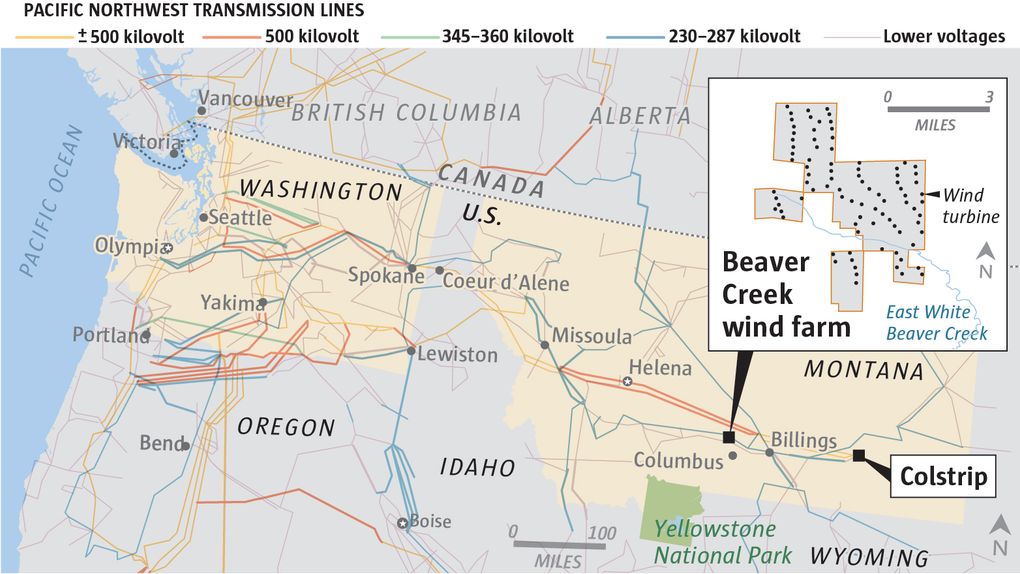
Sources: Esri, Northwest Power and Conservation Council, Puget Sound Energy (Reporting by Amanda Zhou, map by Mark Nowlin / The Seattle Times)
Starting next year, Washington utilities will no longer be allowed to use coal-fired electricity. For PSE, which uses more coal-fired electricity than any other state utility, this primarily has come from power plants in Colstrip, Mont., about 130 miles east of Beaver Creek, and in Centralia in Southwest Washington.
The elimination of this form of dirty power by 2026 is the first of three changes required by the state’s 2019 Clean Energy Transformation Act. The landmark law calls for utilities to become greenhouse gas “neutral” by 2030 and have emission-free electricity by 2045 or risk steep fines.
Montana has some of the most productive land in the country for wind energy. Unlike Eastern Washington, the wind blows strongest during the winter when demand for electricity is highest. PSE also has access to valuable electricity transmission lines through the state, a scarce resource on today’s grid. And unlike in Washington, wind projects have been met with less resistance.
With transmission lines on the horizon, pronghorn antelope roam near the Beaver Creek wind farm in Stillwater County, Mont. (Erika Schultz / The Seattle Times)
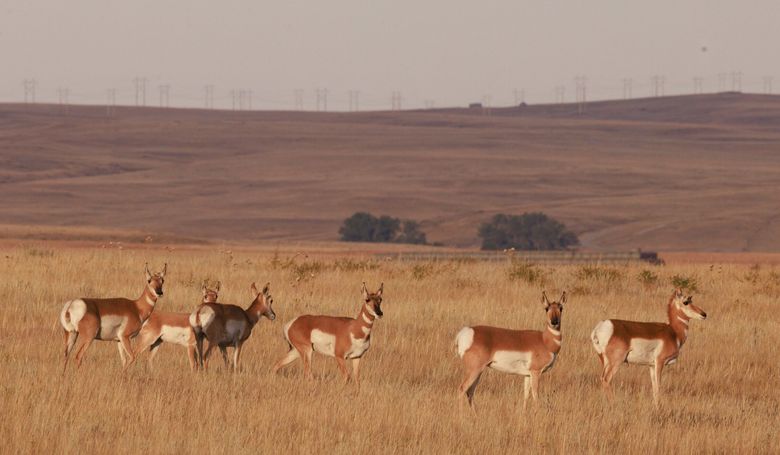
With transmission lines on the horizon, pronghorn antelope roam near the Beaver Creek wind farm in Stillwater County, Mont. (Erika Schultz / The Seattle Times)
Even with PSE’s new wind power, including agreements to buy electricity from two other wind farms in Montana, it won’t be enough to rid itself of fossil fuels. The utility plans to bridge the power gap after coal’s phaseout partially with natural gas, which on paper typically burns cleaner than other fossil fuels but remains a major contributor to greenhouse gas emissions. (The utility has also secured hydropower contracts to ease the move off coal.)
Building and buying new sources of power is an expensive business, and the pressure is ramping up on ratepayers. Over the next two years, PSE electric customers will see an 18.6% rate hike, partially to pay for clean energy projects like Beaver Creek and other efforts to keep the lights on as coal turns off. These changes come amid a federal environment hostile to renewable energy development and unprecedented growth in demand due to data centers, population growth and electric vehicles.
Related | Times Watchdog
How data centers guzzle power, threatening WA’s clean energy push
During the August visit, contractors were all over Beaver Creek, some even scanning the sky for eagles to alert operators of potential lethal collisions with turbine blades. Others were applying a special coating to the blades of powered-down turbines to improve their durability. But soon, preparation would be over. As Western Washington residents reach for their thermostats, and wind and snow rage over the high plains in Montana, PSE will be calling for every megawatt.
Columbus, Mont., a town of around 2,000, sits along the Yellowstone River near the Beaver Creek wind farm. (Erika Schultz / The Seattle Times)
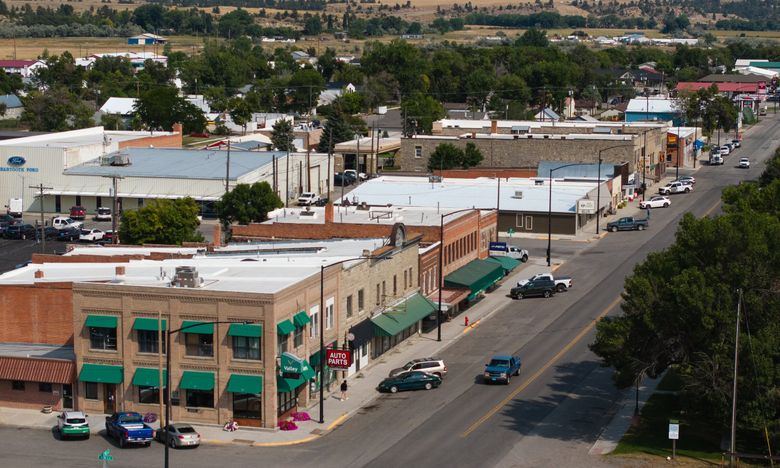
Columbus, Mont., a town of around 2,000, sits along the Yellowstone River near the Beaver Creek wind farm. (Erika Schultz / The Seattle Times)
The future wind capital of Montana?
The development of wind energy in Washington state has been roiled by community opposition and state and local fights. But it’s a different story in Stillwater County.
Beaver Creek’s wind turbines and their eerie red flashing warning lights can’t be seen from Columbus, the area’s largest town with a population of about 2,000, but the wind farm’s benefits have arrived, said Stillwater County Commissioner Roger Webb.
“The good Lord put it here for a reason. Let’s use it,” he said of the area’s wind. “It’s blowing here anyway.”
The project’s developer paid one-time impact fees of about $7 million, which has gone toward renovations at the county’s courthouse, building a new civic center and padding capital improvement budgets for schools, Webb said. If it weren’t for Beaver Creek, the county would have raised taxes this year to round out the budget, he said.
Landowners have also been paid to lease their property to the wind farms, and that can be a saving grace for some families, he said. Beaver Creek and a neighboring wind farm operate in the county, and there are plans for more turbines to come, he said.
Columbus Mayor Webb Mandeville, left, and state Sen. Forrest Mandeville, his son, grill for a birthday party at Forrest’s home in Columbus. (Erika Schultz / The Seattle Times)
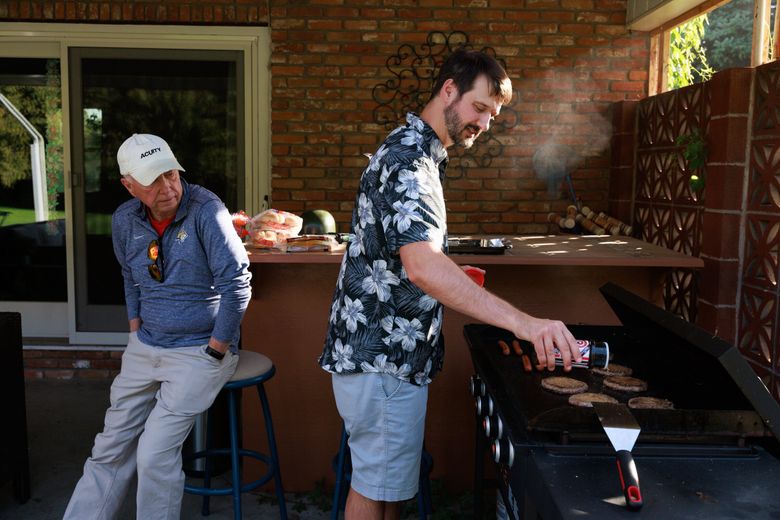
Columbus Mayor Webb Mandeville, left, and state Sen. Forrest Mandeville, his son, grill for a birthday party at Forrest’s home in Columbus. (Erika Schultz / The Seattle Times)
“We want to be the wind capital of Montana, and we’re going to be it,” Webb said.
Most Read Local Stories
- WA weather: Flash flood warning ends after Green River levee fails
- Green River levee fails; flash flood warning ends in Tukwila
- After WA floods, residents scramble for help, insurance to cover costs
- WA floods: Auburn evacuation order issued for some homes
- WA floodwaters swept away their entire house: ‘That’s my life savings’ WATCH
But wind alone can’t replace the benefits of industries like mining or the energy resources of coal and gas, said Republican state Sen. Forrest Mandeville, who lives in town. For one thing, wind doesn’t bring nearly as many jobs or pay as well. Outside of contractors and temporary construction jobs, the wind facilities in the county provide about a dozen or fewer full-time jobs each, he said.
In contrast, the county’s largest employer, the Stillwater Mine, employs around 1,000 people with possible salaries falling around $120,000, he said.
Webb and Mandeville are concerned about the reliability of wind and solar power on the grid, compared with fossil fuels, and say Washington’s climate goals are ultimately unrealistic.
“I think that the impacts of putting carbon into the atmosphere is overblown,” Mandeville said. “I don’t think it’s as big of a deal as some people make it out to be, and if we’re going to have a modern economy, we’re going to need electricity.”
Turbine inspector Robert Shoemaker, with RLS Renewables, works on mouse mitigation and inspections at Beaver Creek. (Erika Schultz / The Seattle Times)
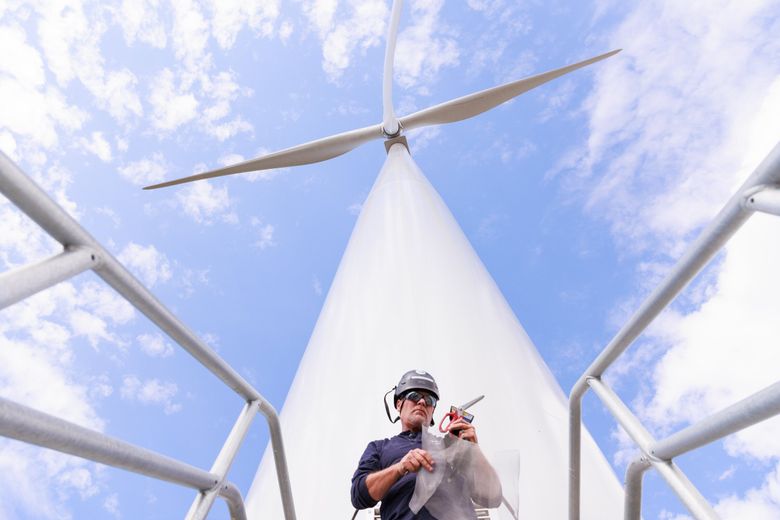
Turbine inspector Robert Shoemaker, with RLS Renewables, works on mouse mitigation and inspections at Beaver Creek. (Erika Schultz / The Seattle Times)
The faces of WA’s new wind power
Trucks idling, Kyle Sullivan unlocked and hauled open the door at the base of a turbine. Speaking to the three other men on-site, his voice echoed up the tall and narrow white can, some 300 feet high. Sullivan, who is currently the facility’s manager, opened a panel to reveal a dizzying array of green circuit boards and multicolored wires, the computer to this space rocket.
Today, the crew’s thrilling task is shoving steel wool into conduits and drilling wire mesh onto the vents and doors of each of the turbines to keep mice from making nests, chewing up and pooping on these sensitive electronics. During construction, mice got into five turbines, screwing up their communications and functioning. With 88 turbines across 17 square miles, the rote but essential work is enough to take up a few days.
The GE 2.8 MW-127m wind turbine
The Beaver Creek wind farm has 88 GE wind turbines across the site.
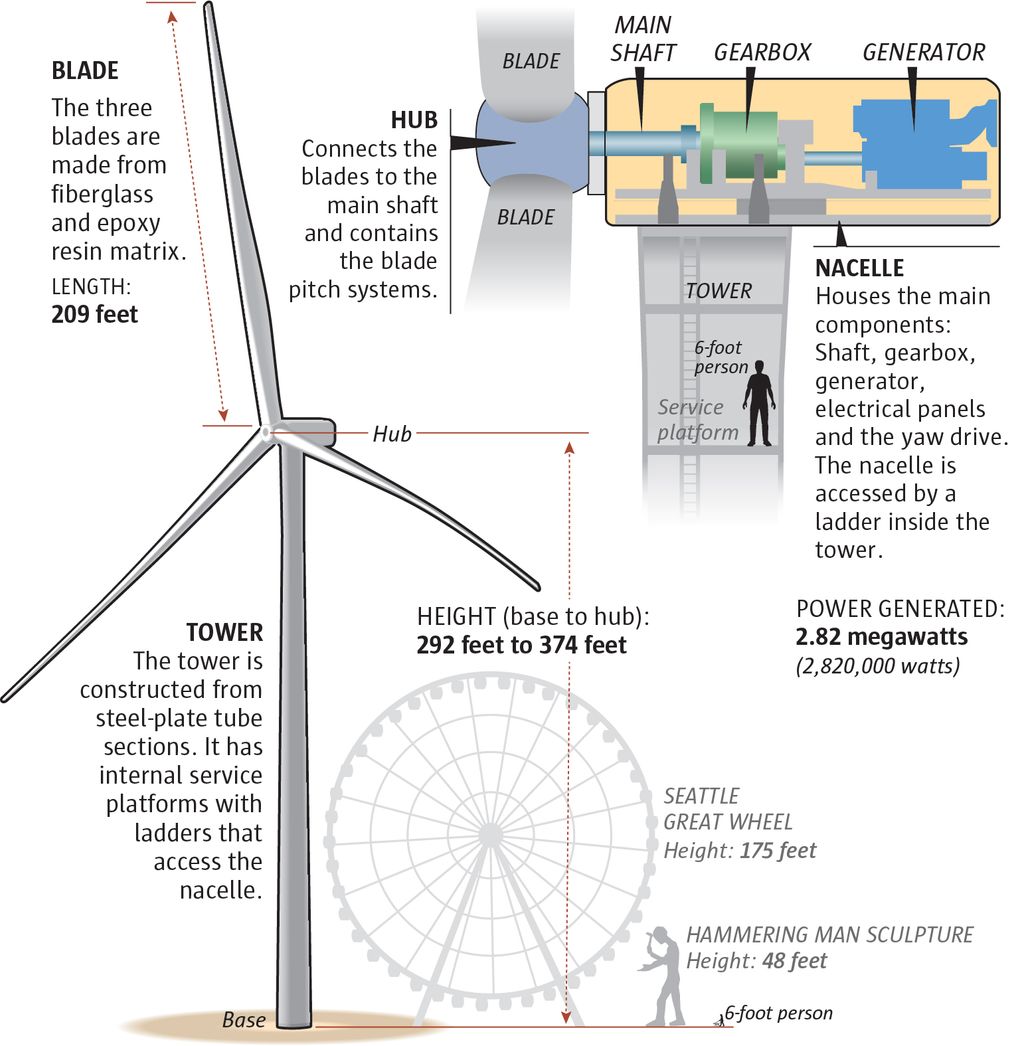
Sources: GE Vernova, windustry.com, dteenergy.com (Mark Nowlin / The Seattle Times)
Chris Flowers, the facility’s plant manager at the time of the August visit, had started working at Beaver Creek about a year ago as the last turbines were being installed, moving to Montana from a coal-fired power plant in Colorado. Flowers, who no longer works at the facility, said he had been looking for a change after being bounced around jobs including at a paper mill, a biomass plant and a solar steam plant.
Coal-fired facilities tend to be old, and between the regulations and costs, many have closed, he explained. Not knowing much about the technology, renewables seemed like a good bet and an industry likely to stick around, despite what President Donald Trump wants, he said.
“The more I’ve learned about wind turbines, the more interesting I find it. It’s actually very neat technology. I mean, if it’s windy, why not capture it? It’s a free resource,” Flowers said.


Former plant manager Christopher Flowers passes through farmland on his way to the Beaver Creek wind farm, home to white-tailed jackrabbits… (Erika Schultz / The Seattle Times) More
While Sullivan and the facility’s project manager Nicholas Cazier are newbies to the wind industry, Robert Shoemaker, a contract turbine inspector, has worked with wind turbines long enough that he knows every sound.
He knows the hum of the generator when it starts up and to look for the blades subtly pitching outward. He knows the low murmur of the turbine turning its massive face toward the wind and the swoosh as the blades chop the air above him.
From Washington to Arizona to Maine, if there are turbines, odds are Shoemaker has worked on them. After joining the industry after a layoff in 2008, Shoemaker said he’s seen wind turbines evolve from lattice tower structures to the sleek modern ones of today.
Communities now welcome workers in the renewable industry, along with the money they spend on hotels and restaurants on their weeks- and monthslong jobs, he said. When Shoemaker first started, he said, towns with ties to oil would often bristle.
Project coordinator Nicholas Cazier, from left, turbine inspector Robert Shoemaker and Kyle Sullivan, now plant manager, work at mouse mitigation and inspections at the Beaver Creek wind farm in Stillwater County, Mont. (Erika Schultz / The Seattle Times)
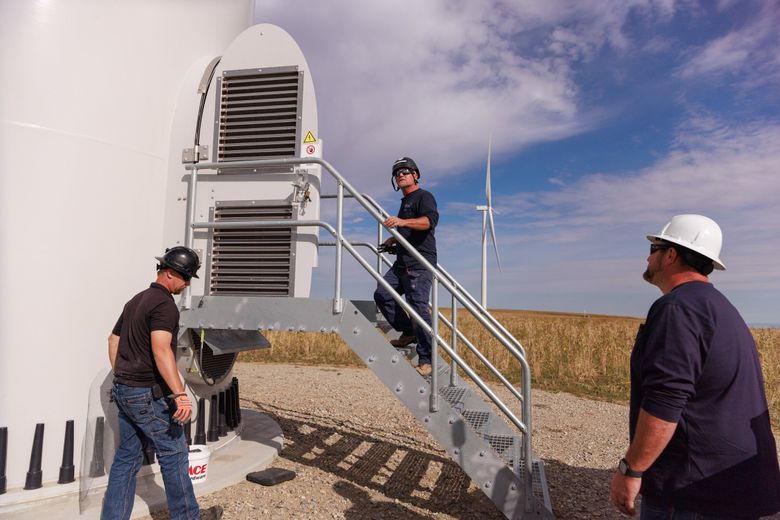
Project coordinator Nicholas Cazier, from left, turbine inspector Robert Shoemaker and Kyle Sullivan, now plant manager, work at mouse mitigation and inspections at the Beaver Creek wind farm in… (Erika Schultz / The Seattle Times)More
“If you pulled in and your truck had a wind farm name on it or a wind turbine, they wouldn’t sell you water, fuel, nothing. You (were) not welcome,” he said.
Cazier and Sullivan joined Beaver Creek earlier this year after being let go by the local palladium mine. Citing low metal prices, the company announced the layoffs of 700 employees late last year.
While many of those employees moved on to other mines in Arizona, Nevada or the Carolinas, Cazier and Sullivan said they wanted to stay in Columbus. The job at the wind farm helped them do that — though Cazier, who used to work underground at the mine, said he ended up taking a pay cut.
Columbus, the county seat of Stillwater County, Mont., is about 40 miles west of Billings. It sits between Interstate 90 and the Yellowstone River. (Erika Schultz / The Seattle Times)
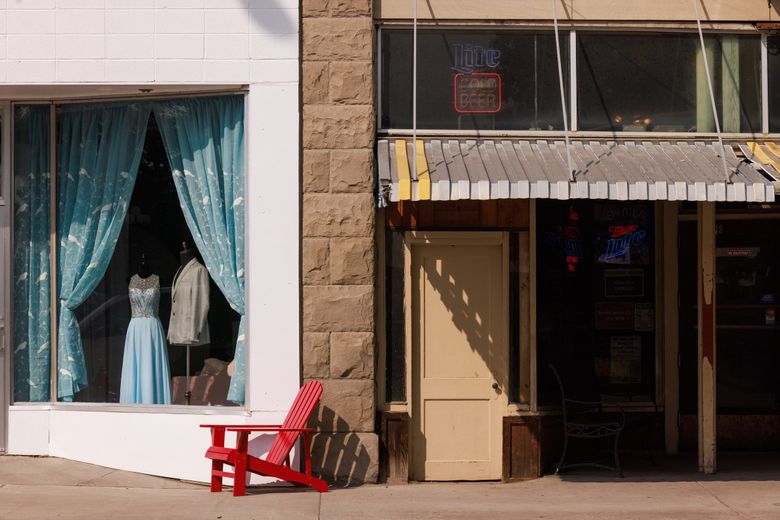
Columbus, the county seat of Stillwater County, Mont., is about 40 miles west of Billings. It sits between Interstate 90 and the Yellowstone River. (Erika Schultz / The Seattle Times)
Washington’s lofty goals
Data centers are sucking up electricity. Consumers are turning to electric vehicles. And more people are plugging in air conditioning amid rising summer temperatures. Utility officials painted a picture of a grid at its limit that just narrowly missed rolling blackouts during a January 2024 cold snap that coincided with an outage at a natural gas reservoir south of Chehalis.
A recent report commissioned by the region’s largest utilities identified coal-plant retirements across the region as a contributing factor to increasing reliability issues, as well as the tepid replacement of that energy, hampered by long regulatory timelines and other issues. While a blackout is still unlikely, the report projected a possible shortage of energy during an extreme weather event starting in 2026, with risk growing through at least 2030.
How Washington’s energy mix has changed
Hydropower has long been the dominant source of energy in Washington, generating around half of the state’s energy in recent years. However, wind has grown modestly as coal has shrunk.
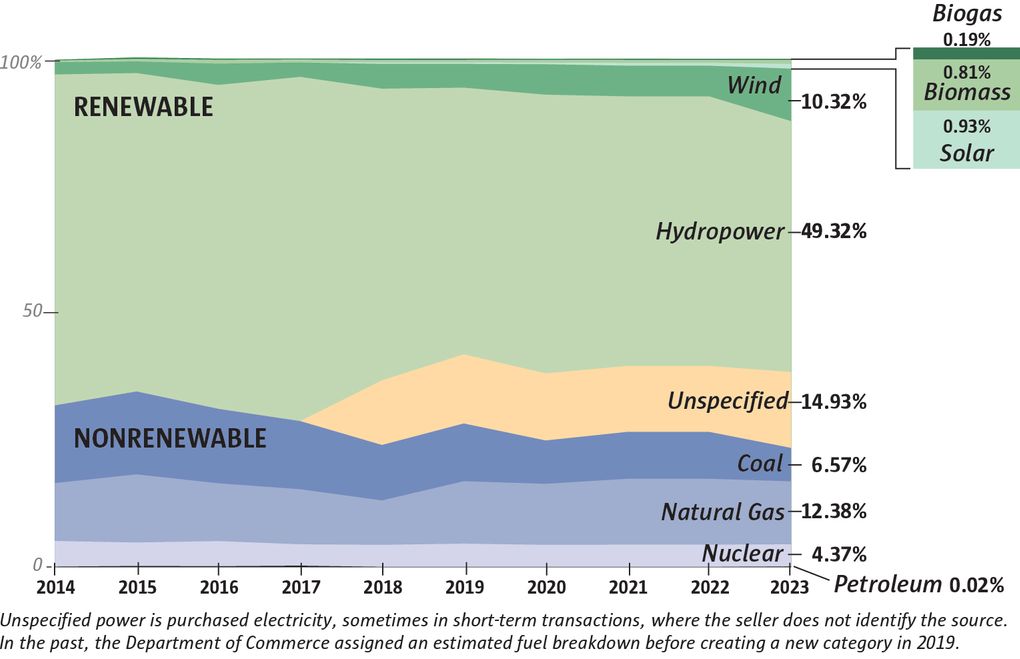
Sources: Puget Sound Energy, state Department of Commerce (Reporting by Amanda Zhou, map by Mark Nowlin / The Seattle Times)
Those reliability concerns are brushing up against the state’s timeline for the clean-energy transition. In addition to the coal shut-off at the end of this month, utilities must use at least 80% renewable sources for their electricity by 2030 and 100% by 2045.
For PSE, meeting this schedule was always going to be “tight,” with most of the renewable resources originally scheduled to come online toward the end of the 2030 deadline, said Matt Steuerwalt, the utility’s vice president of external affairs.
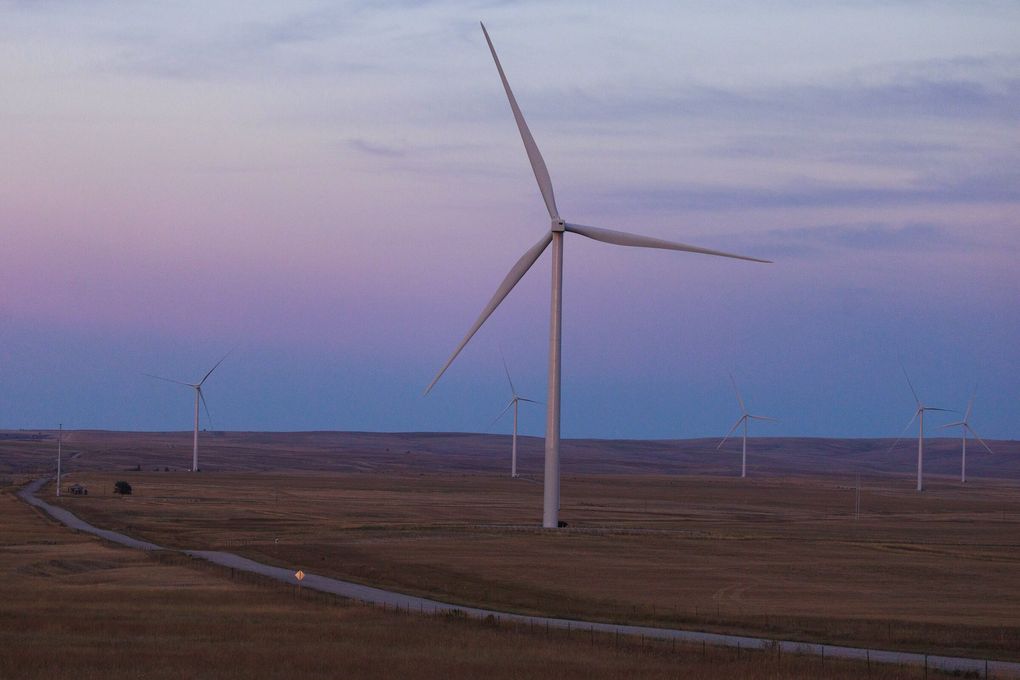
Turbines circle at Puget Sound Energy’s Beaver Creek wind farm in Montana. The wind farm — currently consisting of 88 turbines —… (Erika Schultz / The Seattle Times) More
Despite the cost of solar and wind now competing with fossil fuels, even without subsidies, other barriers to permitting, siting and building transmission lines have hampered efforts, on top of supply chain and labor woes. And that was all before Congress cut clean energy tax breaks this year.
Now the pathway to carbon neutrality by 2030 is not looking so rosy, Steuerwalt said.
While PSE has been steadily adding renewables to its mix in the last few years, just around 50% of its electricity came from renewables in 2024, below a 59% target set by regulators and PSE in 2021. According to the utility, part of this shortfall is due to higher-than-forecast electricity demand, low hydro years and long timelines for new wind and solar resources.
The use of natural gas, which is mostly methane, emphasizes another challenge of moving off fossil fuels in the Northwest with today’s technologies. To achieve the same reliability of natural gas during a cold snap or summer heat wave, utilities must overbuild solar and wind capacity by six- or threefold, respectively, according to analysis.
The utility has forecast in the past that to meet the 2030 deadline, it will need to acquire around 6,700 megawatts of capacity — more electricity capacity than it has acquired in its 150-year history — and most of it must come from new energy projects.
So far, the utility is about halfway toward that goal, though the amount needed has likely changed due to growing demand, PSE spokesperson Christina Donegan said.
Lauren McCloy, a utility and regulatory director of the NW Energy Coalition, said the region is at “a critical moment” where it needs to be building more clean energy capacity, storage, transmission and consumer energy efficiency and reduction programs.
That could mean more fossil fuels to bridge the gap.
“It might be necessary to have a near-term transition where we are using natural gas for meeting capacity needs. We have to keep the lights on, and we have to do this transition affordably,” McCloy said.
What’s clear today: The windy Montana plains are only part of the solution.
Reporting for this article was made possible in part by a grant from the Institute for Journalism and Natural Resources.
Amanda Zhou: 206-464-2508 or azhou@seattletimes.com. Amanda Zhou is a climate and environment reporter at The Seattle Times, where she writes about energy, environmental justice, the intersection of urban planning and climate change — and sometimes, birds.