

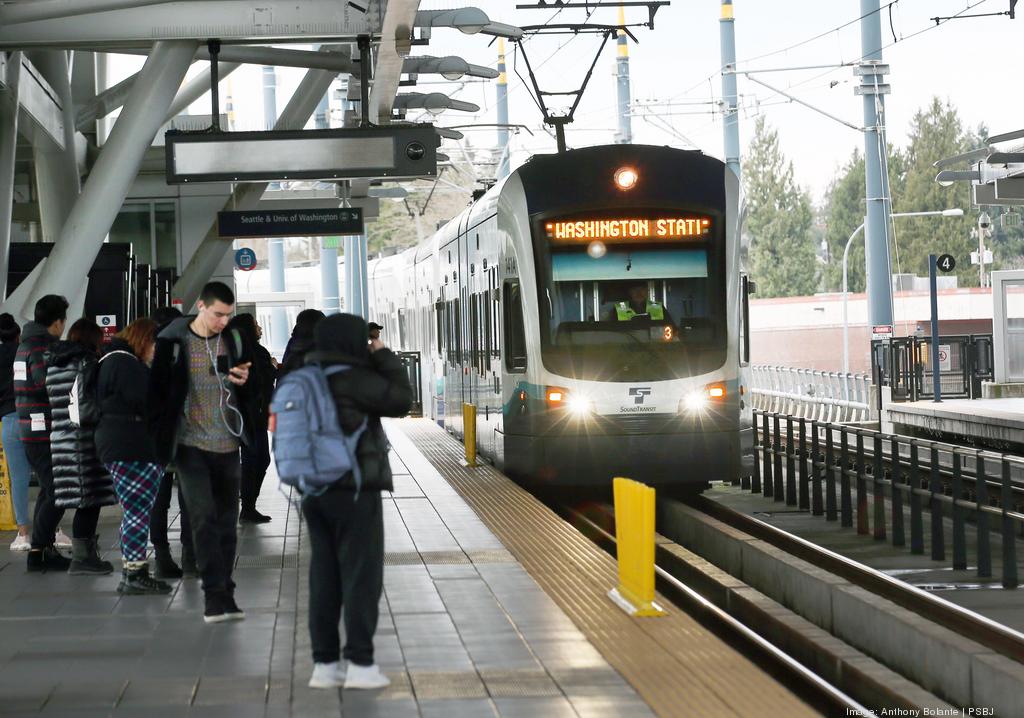
Sound Transit staff have presented a range of scenarios to the board for deferring lines to address its budget shortfall.
Anthony Bolante | PSBJ

By Akielly Hu – Reporter, Puget Sound Business Journal
Mar 18, 2026
Story Highlights
What’s This?
- Sound Transit faces a $35 billion budget shortfall over two decades.
- The Ballard light rail line costs have risen to $22.6 billion.
- The agency plans to adopt specific cost-saving measures later this year.
Sound Transit has a tough road ahead.
The agency has been tasked with building one of North America’s largest mass transit expansion projects, while facing a looming $35 billion budget shortfall over the next two decades.
Ten years ago, voters in the Puget Sound area approved a plan to double the region’s light rail network, among other transit expansions, with new lines to Everett, Tacoma, Ballard, West Seattle, South Kirkland and Issaquah.
But it’s clear now that funding issues will likely require the agency to scale back or defer plans under the 2016 Sound Transit 3 ballot measure.
At a Sound Transit board retreat in Tacoma on Wednesday, staff presented to the board of directors a first look at three different approaches for cutting costs across the entire ST3 expansion.
All three scenarios would involve constructing only a portion of the Ballard line up to either Seattle Center or Smith Cove — foregoing the planned Interbay station and the terminus at Ballard’s Northwest Market Street.
That would be a big hit to the Ballard extension, which has the highest projected ridership of future light rail lines by far. Sound Transit projects it will carry between 132,000 and 173,000 riders daily by 2042.
The line would also incur the highest costs. The price of the Ballard Link, which would involve constructing a second rail tunnel through downtown Seattle, has risen from $11.9 billion to as much as $22.6 billion in the last few years.
Alex Krieg, director of enterprise planning — an agencywide program to alleviate costs — noted that Sound Transit will still try to find ways to deliver the full Ballard line and other potential deferred projects.
“This exercise is really what can we afford based on the circumstances we know now, not what can we ever deliver, period,” Krieg said during a news briefing on Tuesday.
One scenario would defer final construction of the West Seattle line. That extension was projected to carry between 25,000 and 27,000 daily riders by 2042.
Another scenario would not complete the Everett-to-Tacoma spine of the light rail system. It would involve constructing up to the Southwest Everett Industrial Center rather than Everett’s downtown area, and down to Fife rather than Tacoma Dome.
Among the scenarios, there is also an option to defer the South Kirkland-to-Issaquah line.
The board will not make any final decisions but instead focus on evaluating tradeoffs between different scenarios for now. The board’s feedback will inform the agency’s updated expansion plan that will likely incorporate options from all three approaches, Sound Transit CEO Dow Constantine said.
Sound Transit’s board is made up of 18 elected officials representing King, Pierce and Snohomish counties. They are expected to adopt specific cost-saving measures by the spring or early summer.
In most cases, when the agency proposes deferring a line, it would still plan to complete the planning and 30% of the design — the stage at which projects can receive federal environmental approval — on the full project.
All three scenarios involve consolidating the South Lake Union and Denny stations into one station on the Ballard line. All three would also move forward with the additional trips planned for the Sounder South commuter rail.
Krieg noted that these approaches don’t include other financial tools that the agency could use to find more revenue streams and save money, such as in its operations.
At this point, these approaches do not include any delays in the current timelines for planned lines, Krieg said.
Here are the options Sound Transit presented to the board:
Prioritizing current extension projects
The first approach prioritizes active light rail extension projects. In this scenario, Sound Transit would complete the West Seattle line without the station at Avalon. It would build up to Seattle Center on the Ballard line.
This approach would complete the full Everett and Tacoma lines, but defer the South Kirkland to Issaquah extension. It would defer construction of two infill stations — one at Graham Street between the existing Columbia City and Othello stations in South Seattle, and one at Boeing Access Road between the Rainier Beach and Tukwila International Boulevard stations.
It would also defer the T Line extension to Tacoma Community College, as well as the Sounder South extension to DuPont.
Deferring the West Seattle line
The second approach would defer the final design and construction of the West Seattle line. It would construct the Ballard line up to Smith Cove and complete the full Everett and Tacoma extensions.
It would also defer construction of the Graham Street and Boeing Access Road infill stations, the T Line extension and the Sounder South extension to DuPont. In this scenario, the agency would construct the full South Kirkland to Issaquah extension.
Incomplete lines
The third approach would focus on making progress on all planned expansions but completing a few of them.
In this scenario, West Seattle would get constructed up to Delridge station; Ballard would get constructed to Seattle Center; and Everett and Tacoma lines would lack their final two stations, including terminuses in downtown Everett and the Tacoma Dome.
The agency would complete the Graham Street and Boeing Access Road infill stations. It would start the initial construction of the T Line extension and the South Kirkland-to-Issaquah line. It would also complete the Sounder South extension to DuPont