
Some bits of business…
- September 24, 2026 — City Council Regular Meeting, 6:00–10:00 p.m.
- Centennial of the Seashore Club Proclamation
- Update on the Port of Seattle Economic Development Grant
- Development Agreement Ordinance – 2nd Reading
- 2026 City Hall Suite A Restroom & Kitchen Remodel Agenda Item
- Judge Pro Tem Compensation – 2nd Reading
- Marina Tenant Restroom
- Midway Park ORLP Grant Authorization Resolution
- Legislative Agenda
- Comprehensive Safety Action Plan
- Discussion on MFTE Program
- 24th Ave S Improvements Project - S 223rd St to S 216th St - Transportation Improvements Board Grant and Professional Services Consultant Agreement
- Discussion on Capital Improvements on 223rd
- October 1, 2026 — City Council Regular Meeting, 6:00–10:00 p.m.
- Canopy Preservation Program Update
- Draft Funding Recommendations from Human Services Committee
- October 29, 2026 — City Council Regular Meeting, 6:00–10:00 p.m.
- Public Hearing – 2027 Property Tax Levy – 1st Reading
- Public Hearing – 2026 Budget Amendments – 1st Reading
- Public Hearing – 2027/2028 Biennial Budget – 1st Reading
- Executive Session: Property Acquisition Under RCW 42.30.110(1)(b) – 50 Minutes
Future Agendas is the closest thing the City currently has to a calendar of upcoming City Council topics. It’s not always accurate. But until we develop a genuine calendar, this can be useful if there is a particular issue you don’t want to miss.
About the cover
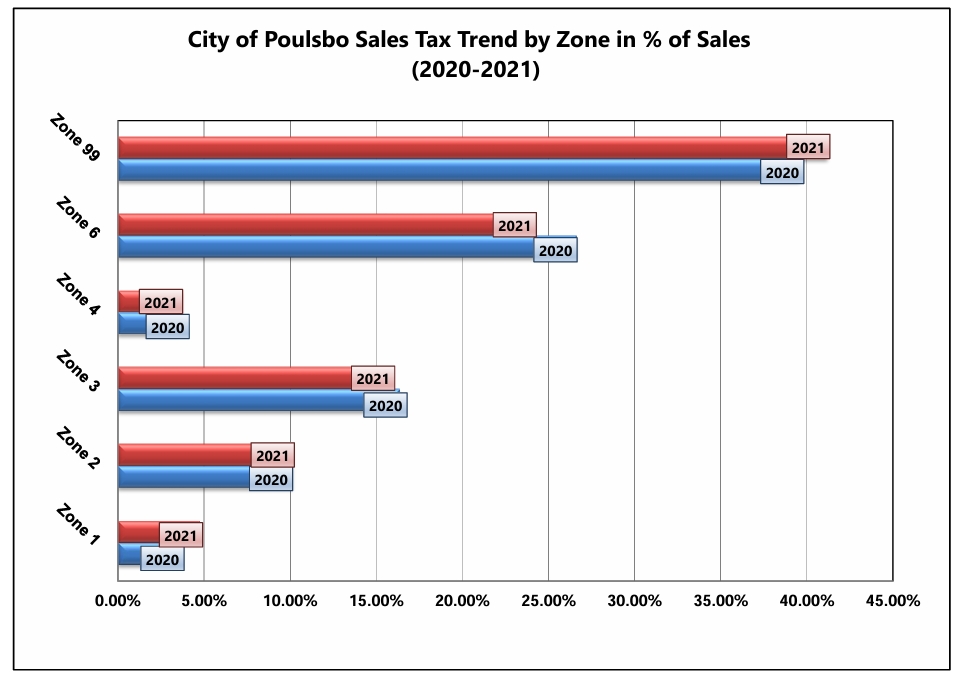
This is a page from a report the City of Poulsbo does I thought you might find interesting. In 2001 they began putting together a ‘sales tax by zone report’. The break their sales tax collections down into the big areas of the city. It’s something I’ve been trying to get Des Moines to do since forever. Opposition to it was so strong it was listed as a reason for my 2023 censure!
Read the report and tell me what you think. 🙂
When I talk about our financial condition, this is one lens I use because it’s so common sense. It makes clear that their downtown (Zone 1, the Historic Downtown–the area everyone loves to visit) drives less than 5% of their sales tax revenue. The part that really powers Poulsbo has nothing to do with that. (It’s actually the mega-mall most of us never visit.) Years ago, Poulsbo decided not to hire fancy consultants but to figure out how to get better ‘analytics’ via sweat equity. (It takes a couple of days to put this kind of report together–it’s real work.) They had no idea whether it would be useful or not.
It totally is.
It’s so good, I did my best to put together the same kind of thing for Des Moines and that is how I began to realise just how little revenue any downtown can ever generate. You don’t use your downtown to drive revenue. You find other economic engines–in our case at the Business Park or on Pacific Highway to pay the bills. That’s the only way you can afford to have the delightful main street everyone wants.
By the way, Poulsbo stopped doing it a few years ago, and that’s another lesson. The results were so consistent, they really didn’t need to keep doing all the repetitive schlepping. My guess is that we’d find exactly the same here because it’s so obvious. But you do the report because I can tell you its results, but it’s just so irresistible to think that their downtown is this ‘economic engine’, you need an official report to change those misconceptions.
I’m fine, too!
A lot of us recall where we were at key moments. I heard about 9/11 with this phone call from my former partner’s wife–they were living near where Flight 93 crashed in Pennsylvania.
“We’re fine. We’re. All. fine.”
And me being me, I replied.
I’m fine too! 😀
To which she replied,
“Turn. On. The. TV.”
The next few weeks weres so surreal, I still don’t know how to think about it. But I can already see people forgetting a little. Just as WWII — even Hitler — are becoming a memory. The first world war? The war to end all wars. Why, that was the war before… you know… the second world war, right?
I grouse a lot about history–up to and including our City–because I am often struck by how much time and money people spend re-learning the same lessons over and over. We just don’t think the same rules apply to us.
I’m not always sure what those lessons are, but I know this: all the digital stuff isn’t helping. In fact, it’s getting tougher for everyone to remember (or care about) what happened last week–let alone 2001.
I’ve heard from more than one person this week something I completely agree with: Before 9/11 was normal. Every day since is not. We may not agree on what that means, but in ways both massive and trivial the entire world is permanently changed.
Having spent several years on the Emergency Management Advisory Committee, I’ve been able to see a bit into what you probably suspect–a lot of the things we did in response to that day were more theatre than anything else. The things that actually prevent tragedies like 9/11 from happening in the first place are things you don’t see; intelligence gathering and a lot of boring diligence as opposed to guns, mass surveillance or taking yer shoes off at the airport. Spending money on real prevention can be a hard sell–especially with ongoing budget challenges and shorter and shorter attention spans.
But I’ll tell ya one thing: I feel safer today not seeing soldiers at airports and not having to do the shoe dance than I did back then.
City Manager Stuff
City Manager Reports! September 11, 2026
The highlight seems to be the Budget Workshop which will have happened by the time this is published.
This Week
Monday
4:00pm Des Moines Airport Committee (canceled)
Tuesday
6:00pm Burien Airport Committee
Wednesday
Regional Transit Committee
Thursday
King County Flood District Advisory Committee: We will present our final budget recommendation letter to the Board (ie. the King County Council.) The good news is that it looks like funding for projects affecting Des Moines (beach park, urban flooding) will be preserved.
Last Week
Wednesday
Emergency Management Advisory Committee. We did a postgame review of public safety responses to FIFA. Since it went pretty well, there isn’t much to report. See above. 🙂
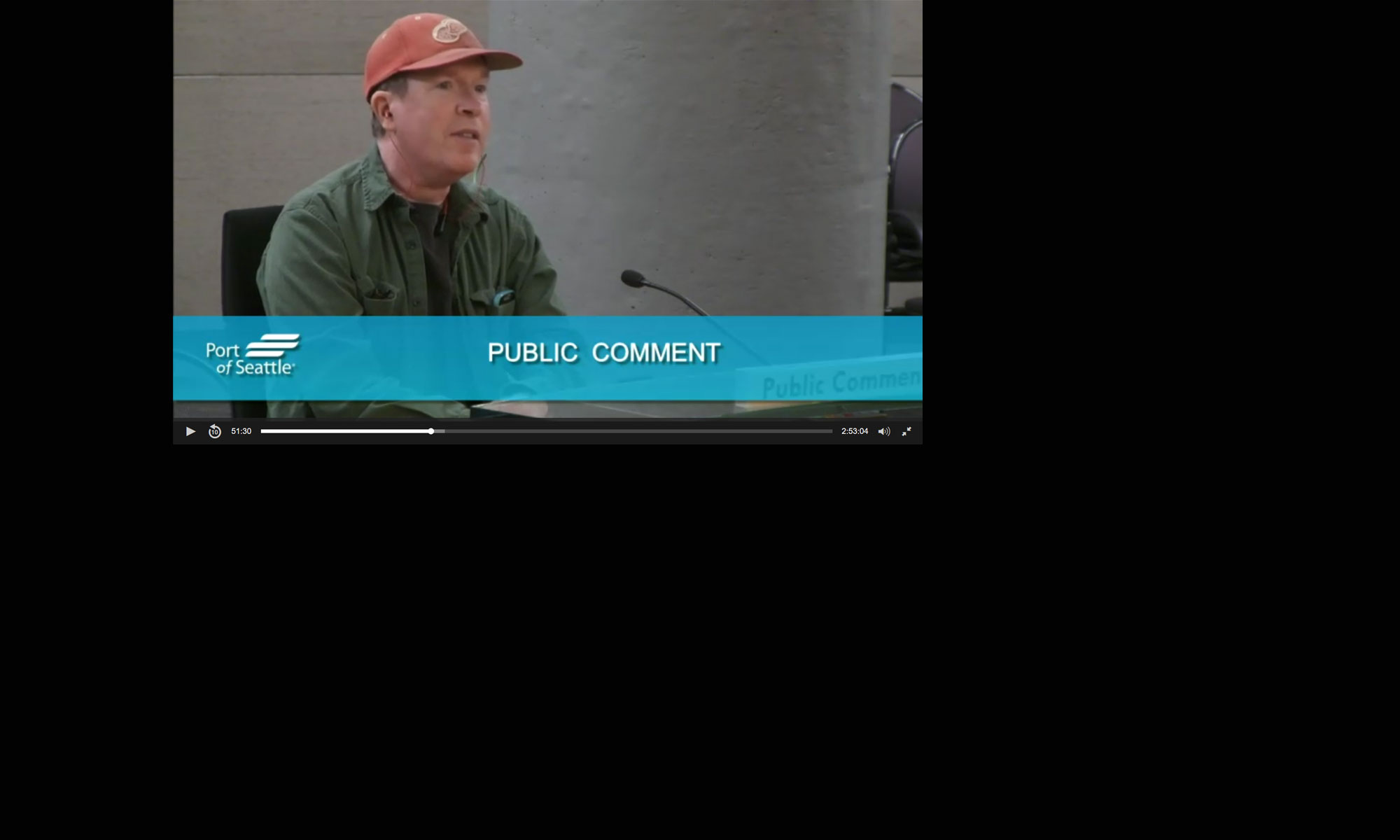
Port of Seattle Commission Meeting. This was their second quarter financial report. Their forecasts often provide a great economic forecast given their nexus with the bond market, foreign trade, tourism, sea and air commerce. (Agenda)
Thursday
September 10, 2026 City Council Workshop Meeting I don’t have a lot to say about this because, well it’s another Council Workshop. Frankly,
Saturday
The Budget Workshop Saturday morning had some good news, which I want to acknowledge and I’ll get to. But overall, it was disappointing for me–and should be disappointing to anyone who has lived here a while–or is intending on living here a while.
It also explains why we haven’t gotten anywhere with the airport. That statement will no doubt exasperate staff who have put in a ton of hours.
The problem is a willful lack of interest in what happened before. People who’ve lived here a while probably care more about now than ten years from now–you mainly want your services protected. Heard. People who have moved here recently have no idea that our financial problems are chronic and that the amenities people always think assume are here, or will be soon, blink in and out but have been in a slow decline for a while. Regardless of previous disagreements, every Council likes to say that “We’ve turned a corner!” And if one objects, one sounds like Debbie Downer.
As above, you sometimes hear me fanboying for the Port of Seattle financial presentations. What is better about their approach is not fancy graphics or charts. It is mostly because they provide backward numbers. Where they were, where they are, and where they are headed. We don’t do that. Why?
People say they want ‘government to run more like a business’. The Port of Seattle is a business; several big businesses, in fact. They must meet certain long-term targets. They can’t simply move the goal posts and declare victory every few years because they have airlines, cruise lines, the FAA, constantly reminding them.
Financial reporting in Des Moines is functionally no better today than when I got on the Council. In some ways, it has moved backwards. The slides look way better. But the information is not because it has become only about NOW. And if all you talk about is now, how do you know where you really are?
FWIW, this is version 2 – the presentation on the video which the Council discussed. It is different from the one on the City website as of this publish date.
- One slide said that the process began with a $2 million gap–which was plugged to zero. Great. But there is no mention of how it was plugged.
- One slide talked about several important staff enhancements. But another said that many are transfers; not additions. So… either we had a lot more dead wood–or we made some even tougher choices. I don’t know.
- The City added a ‘square footage’ tax in 2025–something I started pushing for before I got on the Council. In its first year it generated more revenue than the entire downtown. But after one year, we’re now talking about expanding it–and perhaps raising the rate?
- We just got a card room where the Bartell’s was. Some of my colleagues have been nervous about that. But in its first year it will generate at least 300% more annual revenue for the City than the drug store had in the past decade. So of course, we’re going to immediately increase the gambling tax.
For me, the biggest disappointment is that we are essentially giving up on the rule the Council established in 2012 saving one-time construction fees for future projects. Over and over during the 2013 crisis, leadership said that the City must learn to budget only with stable sources of revenue (property tax, utility tax, retail sales tax.) Agreed. But even with all that rhetoric, it never happened. Most years, we’d hit a budget gap and vote to override that. The budget rebounded only because of a ton of construction money hit in 2016.
In 2021, the Council reached its highest levels of public safety and human services spending–but only because of a $9 million check for COVID. So within two years we were (again) reducing services.
Even with those new revenues and moving the goalposts, this budget does not get us back to 2019 in terms of our ability to provide basic services–including police.
We tend not to address the underlying financial and structural issues because it’s easier to declare victory. And one way to do that is to simply avoid talking about either the past or the future.
We plug them as best we can and then go right to building something the current Council finds interesting–with no measure of fiscal benefit or sustainability.
Eventually, if you just keep at it, a hotel, a business park, a theatre, a ferry, a marina steps, a ‘downtown redevelopment’ will provide ‘the unlock’. Maybe. But overall these just strike me as more “If you build it they will come.” And if you’ve heard this joke before, forgive me. But in the movie, Kevin Costner was literally betting his farm listening to voices nobody else could hear.
With all my whinging–back to that square footage tax. As I said, I began beating on that before I got on the Council as part of Sea-Tac Noise.Info. I only noticed it because it was an airport project. That development was meant to mitigate and compensate the City of Des Moines for some of the negative airport impacts from the seventies. It was always meant to be our little ‘economic engine. Instead, it had been a complete money pit for us for decades. The area lay fallow for so long people thought it was ‘a forest’ and then, even after the Port developed it, no one noticed that it provided basically zero tax benefit to the City.
One might wonder where this years’ budget would be if that new tax hadn’t come on line. There is a lot more compensation to be had from the airport. But this Council and the City treats anything to do with the airport as a total PITA.
Some previous colleagues accused me of having ‘no vision’ in my opposition to things like a passenger ferry and the Marina Steps. I’ve never quite known what to do with that. My idea of ‘vision’ is having $600,000 in cash every year from Port Property–not spending $800,000 on empty dreams like a passenger ferry or saddling residents with $1,100,000 every year in interest payments on the Marina Steps.
The Perception of Safety
In any town hall you go to around here–any city–the number one concern will be ‘public safety’. Our city has its own police force. Other cities like Burien and SeaTac contract with King County. The numbers will vary, but no matter what people think, basically every city already spends every available dollar on public safety. There are objectively fewer police officers now that in recent years and yet crime is down in almost every category. On the other hand WA has ‘the lowest officer/resident ratio in America’.
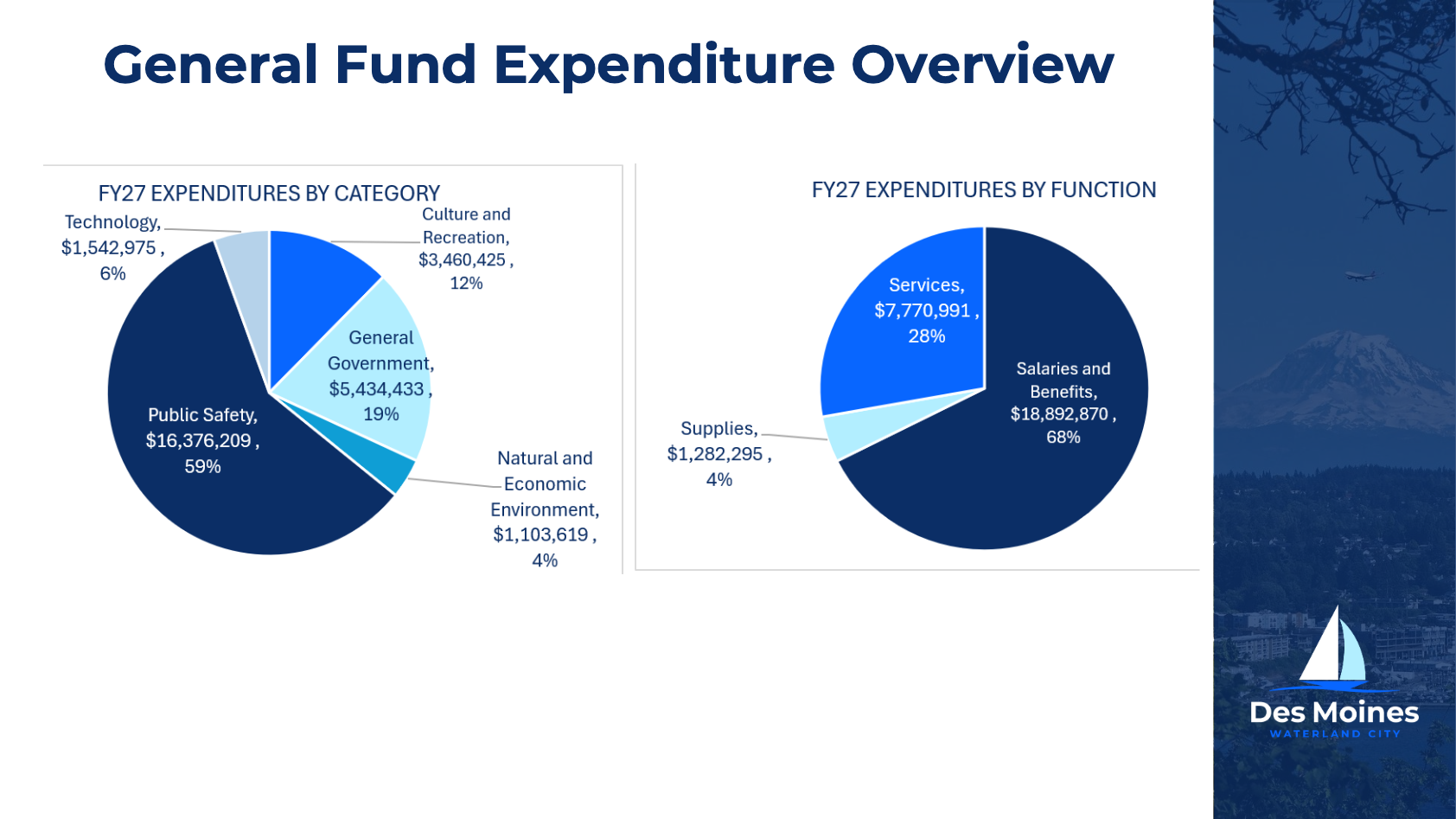
Ultimately ‘do I feel safe?’ is what people care about. But we should at least know what the numbers say and our system makes it almost impossible to compare. For example, this is ‘the pie’ the Council saw on September 12th. 59%
But wait! At our last Citizens Advisory Board meeting, this was the ‘pie’ presented for 2026. 44%.
Yes, I can read. 59% is for ‘public safety’ and 44% is for ‘police’. But that’s not the point. The point is: why have two different pies at all? Why not simply define what ‘public safety’ means and present the same pie all the time so people can compare apples to apples in the… er… apple pie. 😀
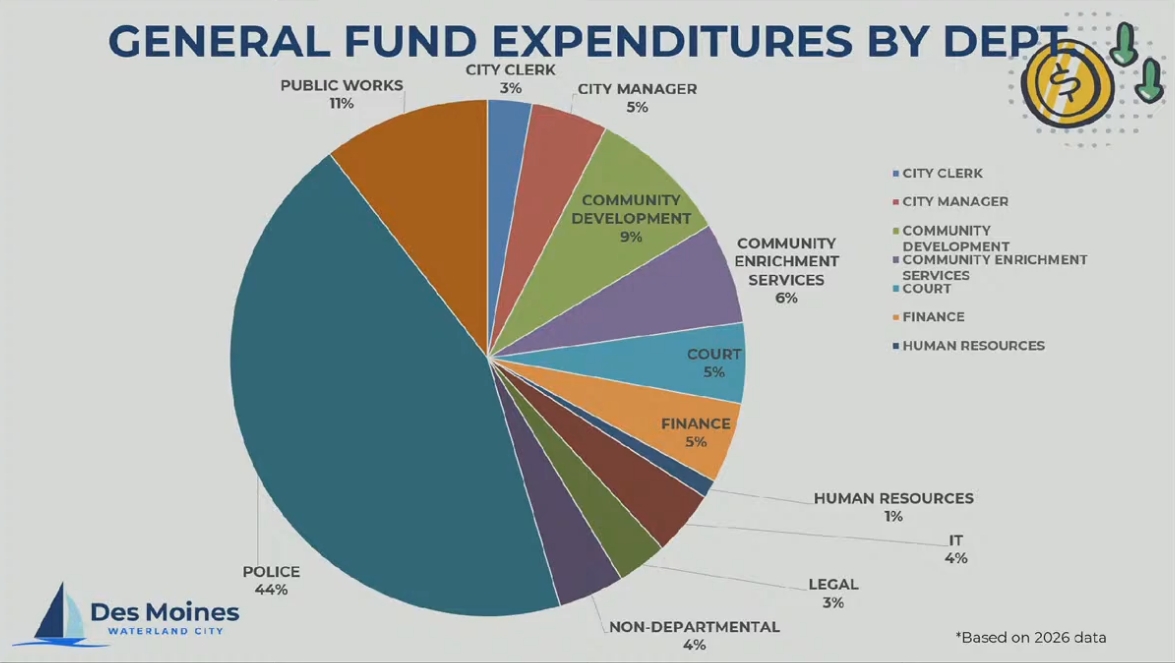
This shows an indifference to truly informing the public how things are going. Imagine if the government number (unemployment, inflation, GDP) was presented differently every month or year. People would either stop trusting–or caring. As it stands, all we’re telling people is, “Boy, we sure do spend a lot of your money on public safety! Yessireee, Bob! See how big the slices are?”
You deserve something standard and a bit more precise than that.