
By
Special to The Seattle Times
RUN YOUR FINGERS through a dense sea otter pelt or along the rough edge of whale baleen. Delicately brush the tentacles of a neon green anemone or the spines of a purple sea urchin. Check out the tiny bones of a kingfisher or the massive ones that comprise a 38-foot-long gray whale skeleton.
All of this is possible at MaST Center Aquarium, a marine biology teaching lab for Highline College students and for the surrounding community. Located in Des Moines, King County, the aquarium stokes interest — and investment — in the well-being of Puget Sound marine life.
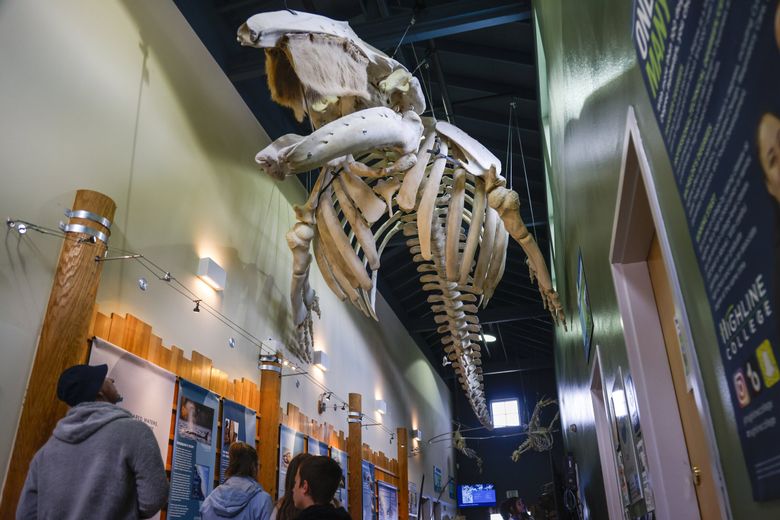
Visitors walk under a 38-foot gray whale skeleton in the entrance of the MaST Center Aquarium’s main facility in Des Moines. (Andrew Burke-Stevenson / The Seattle Times)
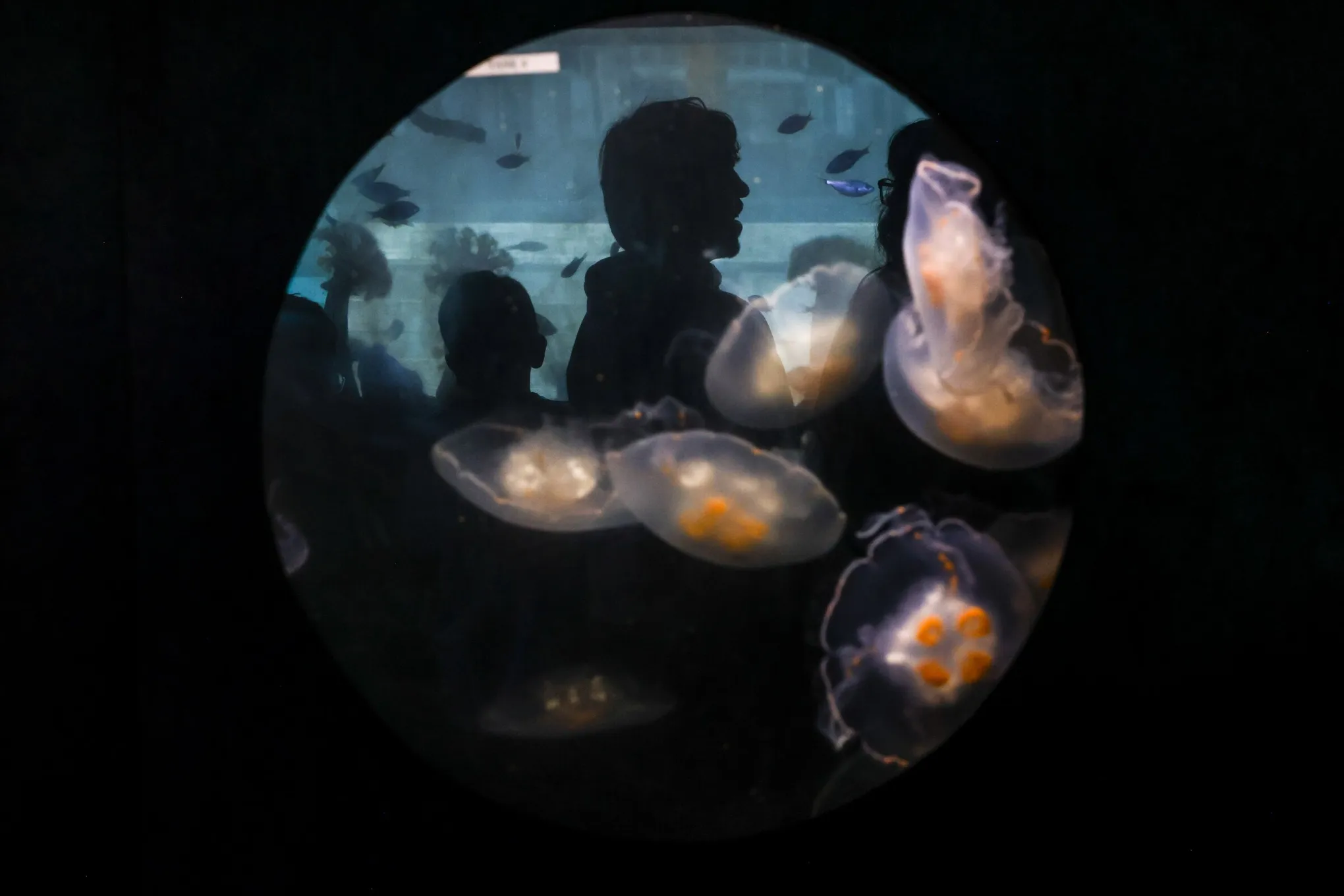
In July and August, the aquarium opens for free to the public on Saturdays and Sundays. (It’s open for visitors only on Saturdays during the rest of the year.) Volunteers eagerly guide people through the displays, pointing out the differences between a shiner and striped perch, the transparent digestive system of a jellyfish, or which animals tend to eat their tankmates.
In the center’s entry, visitors are greeted by the skeleton of a gray whale that washed ashore in West Seattle in 2010; it now hangs from the ceiling. In a nearby display, you can also see the human trash, including a golf ball, that was found in the whale’s stomach.
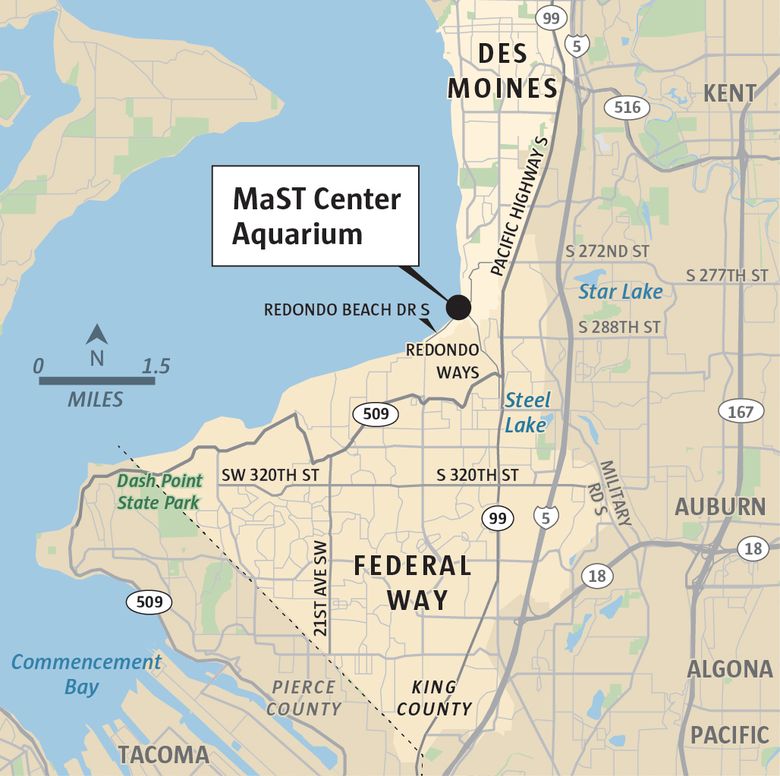
Source: Esri (Map by Mark Nowlin / The Seattle Times)
MaST Center Aquarium: 28203 Redondo Beach Drive S., Des Moines; mast.highline.edu; 206-592-4000.
The MaST’s two buildings, which sit on a Redondo Beach pier extending over Poverty Bay, house a classroom, laboratories, offices and an aquarium with 15 tanks and two touch pools. The tanks and pools contain 250 species native to the Puget Sound, from the tiny Pacific spiny lumpsucker to the predatory leather sea star. Faculty and students from the college are here daily doing lab work for classes, while volunteers support larger research projects, such as monitoring harmful algal blooms and counting Dungeness crab plankton to predict population and effects (this year, they’re a month early). Field trippers from nearby K-12 schools visit periodically.
People have positive and negative misconceptions about marine biology, says Rus Higley, director and one of the founders of MaST. “They think it’s about dolphins and sea turtles, coral reefs and Nemo [the cartoon clownfish in “Finding Nemo”]. They think it’s flashy, and you’re always scuba diving, and you’re always on a boat.” Conversely, some people have fears around animals in the deep, dark sea, like sharks.
Part of the role of MaST, as Higley sees it, is to replace fantasy and fear with appreciation for the real beauty and importance of the teeming marine life in our backyard.
Des Moines is one of the best places, for example, to see bluntnose sixgill sharks (the city bills itself as “the sixgill shark capital of the world”); these animals visit June through September and you have to scuba dive to spot them in their depths. Sixgills are not a threat to humans (Higley points out there have been just two documented shark attacks in Washington state history) and MaST celebrates them at its annual Shark in the Park community event.
Many people are familiar with orcas but are less versed in the Puget Sound’s many other impressive species.
“I joke, the tropics are kind of like the 1980s, over the top, big hair, bright pink, bright colors; Seattle, we’re a little more subtle, we’re a little less ostentatious [and] that’s what our marine life is,” Higley says. “But if you slow down and look at it, it’s full of just amazing critters.”
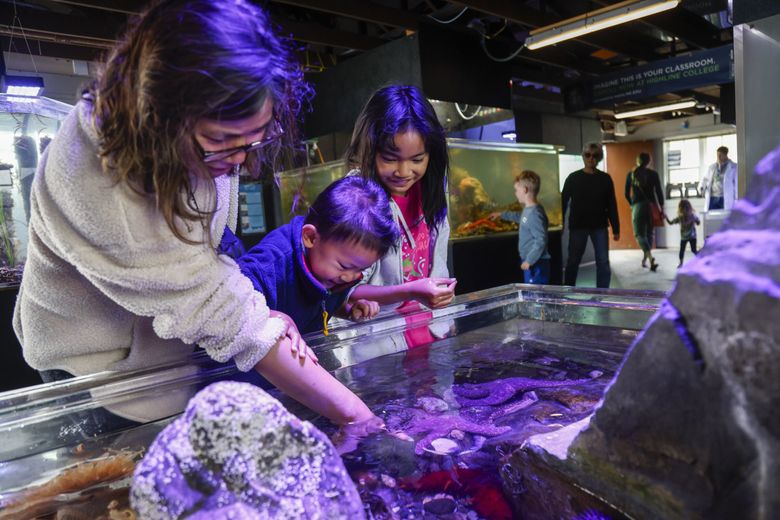
Vy Dao, left, Oliver Tran, 2, and Addison Tran, 9, explore a touch tank at the aquarium during one of its Discovery Days, when it opens for free to the public on Saturdays and Sundays in July and August. The rest of the year it’s open for visitors… (Andrew Burke-Stevenson / The Seattle Times)More
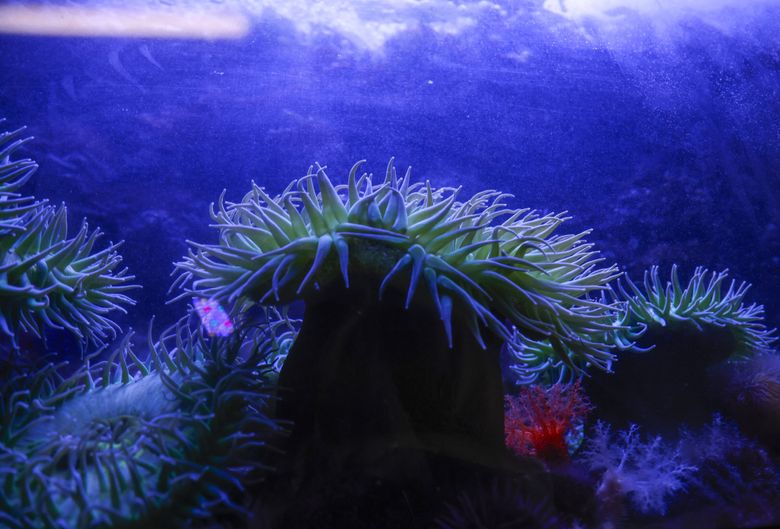
Green anemone in a tank glow under UV light at the MaST Center Aquarium in Des Moines. (Andrew Burke-Stevenson / The Seattle Times)
That includes some of the largest anywhere in the world, like sunflower sea stars, gumboot chiton and anemone, and the longest lived, the rougheye rockfish, which can survive more than 200 years.
The idea for the aquarium was seeded when Higley and a few other faculty began to bring their oceanography and marine biology classes from the college to the pier, where a neglected building for the college’s former commercial diving program remained. There was no running water, but the experiential classroom worked so well that they decided to renovate it into a real research center.
College faculty and staff constructed some aquarium tanks and got others secondhand. “Our first tank was made out of 4-by-4 lumber and pond liner from Home Depot,” Higley says. Others, “were 40-year-old given-away tanks from the Seattle Aquarium that had gone to two or three other places.” At least one met its end just as MaST opened to the public in 2003: “I remember literally standing right in front of one, watching it as it exploded with animals and water in it.” The aquarium got a full state-of-the-art rebuild a few years later, reopening in 2008.
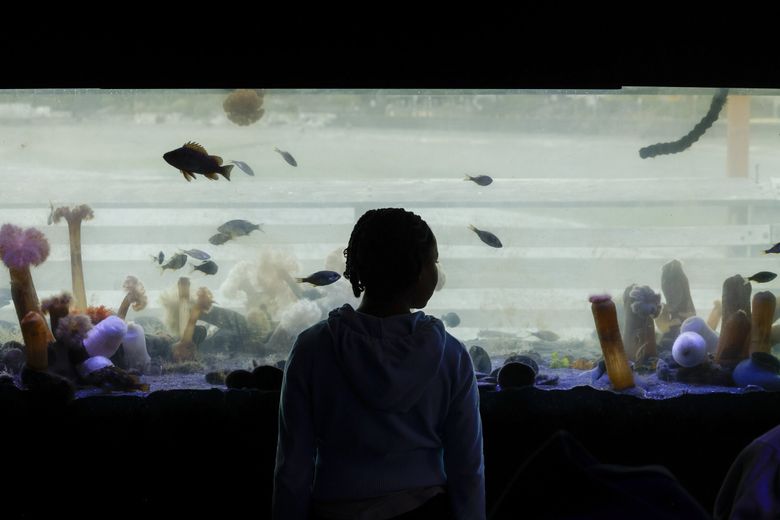
A young visitor looks at a fish tank with a view of the pier at the MaST Center Aquarium on Redondo Beach in Des Moines. (Andrew Burke-Stevenson / The Seattle Times)
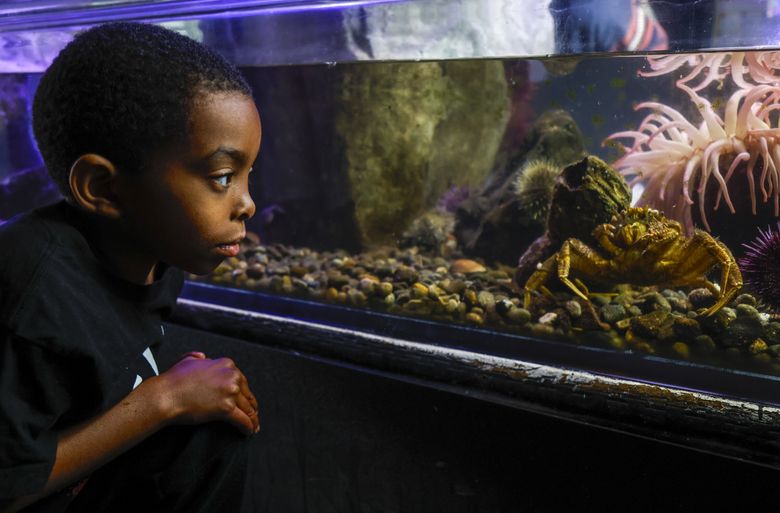
Khalil Smith, 7, watches a crab in a touch tank at the MaST Center Aquarium in Des Moines. (Andrew Burke-Stevenson / The Seattle Times)
MaST gets its name from Marine Science and Technology. Most of the students who come to the center for class may not be interested in becoming marine biologists, or even passionate about science; they’re looking to fill lab science credits. But when they learn about plankton off a dock, build underwater drones and run them to collect samples, or use the underwater hydrophone and Microsoft’s AI to detect, record and analyze sounds, “all of a sudden the science becomes really real,” Higley says. It’s exciting, and students gain lifetime skills, like how to look at data, as well as a clear view of the ways their daily lives and choices can affect the environment.
Most students who attend Highline College — for certificates, two-year degrees and four-year applied bachelor’s degrees — live nearby. Together they comprise one of the most diverse college communities in the state, with over 120 languages spoken.
“We’ve got these experiences that are world-class for our little community aquarium,” Higley says. That goes for non-students as well. Volunteers can begin as young as age 10, and options include teaching the public about the aquarium, taking care of aquarium tanks and animals, assisting in collecting scientific data and helping lead visiting school groups.
After more than two decades at MaST, Higley now sees people who once visited as children come back as Highline students or volunteers. A few have even gone on to study marine biology. “This feeds a part of their soul,” Higley says. “It’s all about community involvement, community engagement, and how do you get people interested in these things.”
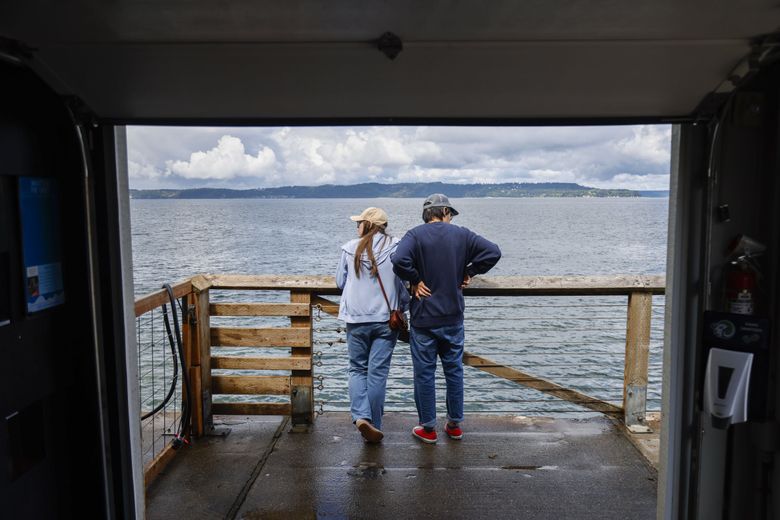
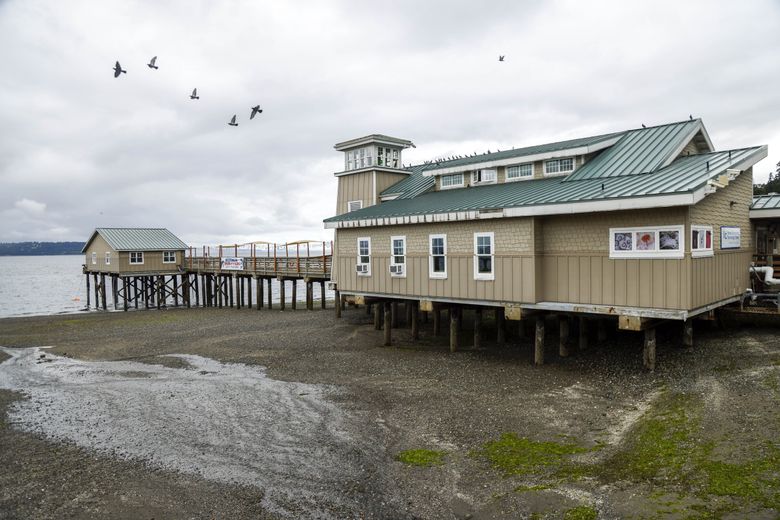
1 of 2 | Visitors look out over the pier just outside the aquarium at the MaST Center Aquarium on Redondo Beach in Des Moines. (Andrew Burke-Stevenson / The Seattle Times)
BY THE NUMBERS
18: Average length in feet of a bluntnose sixgill shark
205: Age of the oldest recorded rougheye rockfish
3,000: Gallons of seawater flowing through the MaST tanks from Puget Sound
1,400: Weight in pounds of MaST’s gray whale skeleton (nicknamed the “Arroyos whale,” for the neighborhood where it was found)
Share your Sense of Place idea with us
Know of a unique person, place or event tied to particular spot in the Seattle area? We want to hear about it! And we might feature it in a future Sense of Place story.
In this weekly column, Tantri Wija and other writers dive into a place, thing or event set in a particular neighborhood or area. Each story is accompanied by photos, a map and a few fun facts.
Niki Stojnic is a longtime Seattle-based freelance writer and editor covering people and places in the Pacific Northwest and beyond; you can find her on Linkedin or Instagram @nikistojnic.