

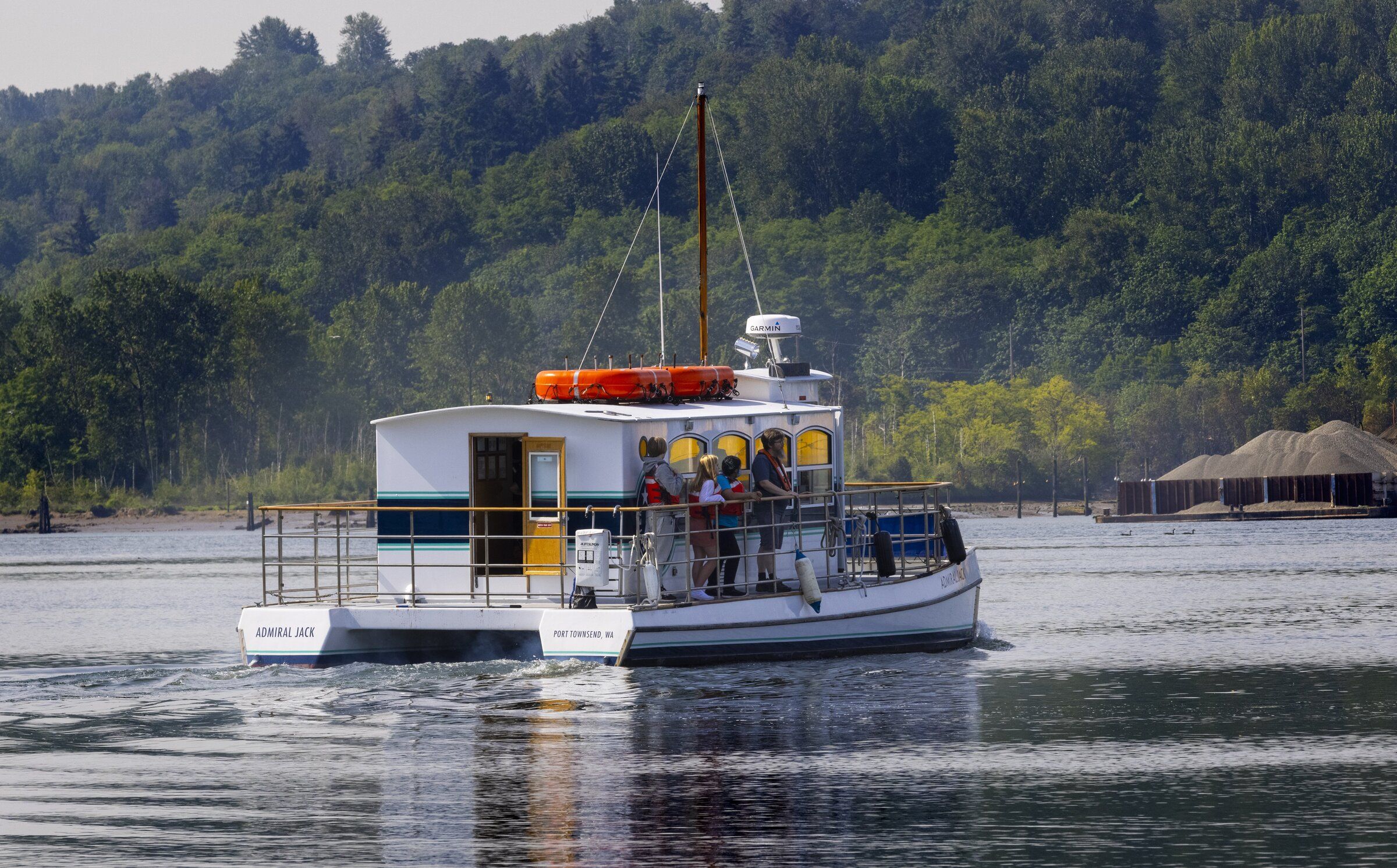
Maritime High School students take their last voyage of the year aboard the Admiral Jack on the Duwamish River in West Seattle. The students use the 40-foot passenger ferry as their floating classroom and… (Ellen M. Banner / The Seattle Times, 2022)More
Seattle Times education reporter

Education Lab is a Seattle Times project that spotlights promising approaches to persistent challenges in public education. The Seattle Foundation serves as the fiscal sponsor for Education Lab, which is supported by grants from the Bill & Melinda Gates Foundation and Ballmer Group. Learn more about Ed Lab and subscribe to our weekly newsletter.
Nearly five years after Highline Public Schools opened a high school to prepare students for maritime industry jobs after graduation, the school is still finding its sea legs.
Maritime High School is in a temporary building in Des Moines, with no site for a permanent home. It has 110 students, below the 400 envisioned when it opened in 2021, and seven classroom teachers.
And with one graduating class out the door, a group of parents and former students say the school has work to do to achieve its goals. They’ve complained about the quality of the academics, which forced some parents to pay for extra math classes and left some students feeling unprepared for college. Disruptive teacher turnover, program changes and poor communication have also been sore points, they said.
Yet others have said that despite the challenges, the school is offering a unique student experience.
The school aimed, in part, to increase the workforce in a sector with an urgent need for younger workers and draw girls and others from underrepresented backgrounds to well-paying jobs, ranging from ship operators and marine biologists to naval architects.
Jamila Gordon, the school’s principal, said interest in the choice school remains high.
Out of the 35 students in the first ninth-grade class, 25 were part of last June’s graduating group. Graduates went to maritime-focused colleges — two got accepted into Cal Poly Maritime in Vallejo, Calif. — and other four-year universities, Gordon said. Two got jobs with Washington State Ferries, and some were undecided, she added.
This year, girls made up nearly 33% of the school’s enrollment, and close to 46% are not white, according to state data.
Gordon said the school has been trying to respond to the community’s needs. It added daily discrete math classes in ninth and 10th grades last school year and Algebra 2 in 11th grade this year after hearing the math courses were not rigorous enough.
She touted last year’s addition of the marine construction pathway, which had 14 students last semester. Families were pleased with a ninth-grade financial math course added this year because it offered practical skills about money and finance, she said.
In another big pivot, the school announced in January that it would end a partnership with Seattle Maritime Academy in Ballard, where 11th and 12th graders in the school’s vessel operations program take college-level courses and get practical experience. The change will start with this fall’s 11th graders.
Port Townsend-based Northwest Maritime will run a similar program in its place.
Tove Tupper, a district spokesperson, said the changes were because students were struggling at SMA. About a third had trouble completing SMA’s classes, she said in an email.
The move shocked Darcy Birkeland, who has complained to the district since 2024 about academics, leadership and what she called “poor communication” from Gordon.
Sign up for Education Lab
An easy way to stay connected to education. Delivered to your inbox Thursdays.
“The pathways have changed almost every year,” said Birkeland, whose son, Eli Powell, 18, is a senior and spends four days a week on the SMA campus. “They need to find something that’s sustainable, and reliable, and consistent.”
From left, Darcy Birkeland and Jevon Powell with their son Eli Powell and his classmate Jack Chiodo Jr., from Maritime High School, near the Fauntleroy Ferry Terminal in West Seattle. (Ellen M. Banner / The Seattle Times, 2025)
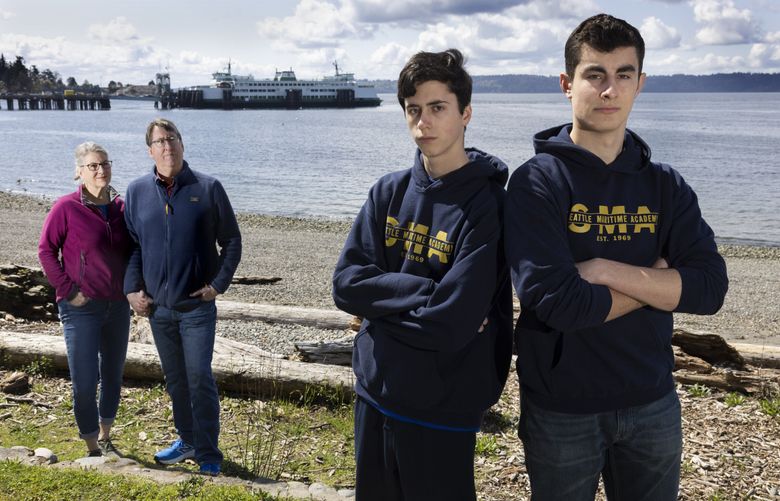
From left, Darcy Birkeland and Jevon Powell with their son Eli Powell and his classmate Jack Chiodo Jr., from Maritime High School, near the Fauntleroy Ferry Terminal in West Seattle. (Ellen M. Banner / The Seattle Times, 2025)
Tupper said bringing students back to the high school campus will allow staff to offer academic interventions and support students who need multilingual or special education services. Students in the three pathways, which also include marine science and marine construction, will all now spend part of the day on campus. The school could save nearly $100,000 annually from transportation and fees, Tupper said.
Students will graduate with the same credentials, Tupper said. But the high school now envisions students going to SMA, work or college after graduation.
But the change will delay the time it takes for students to earn one key credential: the qualified member of the engine department, which sets them up for an above-entry-level job on a ship.
Maritime High School graduates who’ve completed the SMA classes and a 90-day internship can apply for that credential in part because the U.S. Coast Guard approves SMA’s instructors and courses, said Dale Bateman, SMA’s associate dean.
The courses in the new program will still give students a practical and theoretical grounding in the maritime industry, including its history, careers, safety and regulations and how to use common equipment, Northwest Maritime officials said. They also intend to seek Coast Guard approval.
Most Read Stories
- Alysa Liu, other figure skating Olympians to perform in Seattle
- The Joe Kent saga lays bare the real Trump derangement syndrome
- Woodinville’s former Molbak’s location to take new form, again
- Man who killed Belltown restaurant owner found not guilty
- Most-visited WA state parks in 2025: 10 to go to if you haven’t yet
“It’s around getting real skills that are related to entry-level careers onboard vessels,” said Jake Beattie, Northwest Maritime’s CEO.
Some parents and current and former students said they expected turbulence enrolling in a startup school in 2021. Students built canoes, tested water samples and spent time on a passenger ferry that serves as a classroom on the water. Industry leaders visited and mentored students.
The bigger shift started in 2023 after the school’s founding principal, Tremaine Holloway, left, some parents said. Staff followed, they said. Gordon pointed out that staff turnover was not uncommon after a principal’s departure.
Maritime High School Principal Tremain Holloway speaks to students while standing on the beach at Seahurst Park in Burien next to the four 18-foot ‘Peace Canoes’ the ninth graders built throughout the year as part of their STEM curriculum and maritime training in 2022. (Ellen M. Banner / The Seattle TImes)
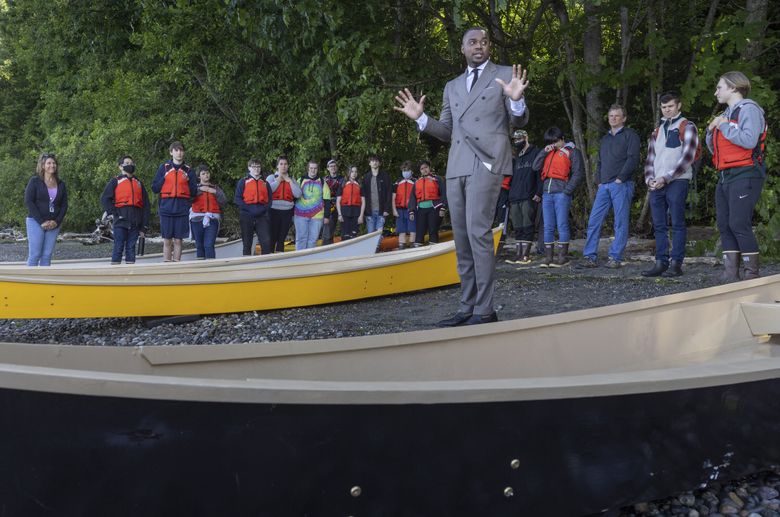
Maritime High School Principal Tremain Holloway speaks to students while standing on the beach at Seahurst Park in Burien next to the four 18-foot ‘Peace Canoes’ the ninth graders… (Ellen M. Banner / The Seattle TImes)More
The addition of Running Start, the dual-enrollment program allowing high schoolers to take classes on college campuses, drew mixed responses from families who’d expected a full project-based experience. And last year’s graduating class had to use Rosetta Stone units to meet a world language requirement, former students said.
Math was an almost immediate concern because it was not taught as a separate subject.
April Campbell, whose son is now a senior at the school, said she had to get him a math tutor — and a precalculus class last summer — so his skills would be strong enough to pursue his interest in aerospace engineering.
By the time he got to 11th grade, Campbell said SMA was almost “an escape valve” from the Maritime campus, where she felt he wasn’t learning much.
Campbell did credit Maritime with helping its students become master public speakers because they are required to demonstrate what they learned through projects and presentations. Students do not receive traditional letter or numeric grades for their coursework.
“We came out OK,” Campbell said, adding she’d caution anyone to ask a lot of questions before going in.
“I feel like we were successful because we were strategic and diligent in building other things around him,” she added.
“I think because he got into (college) where he wanted to go, it’s a success. But I think it could have gone either way. I think we got lucky.”
Birkeland and her husband, Jevon Powell, have been campaigning to get the school and the district to focus on academics and create more opportunities to hear from parents and students.
Her complaints have gone up the chain, from the principal to the superintendent, without resolution. She filed a complaint with the district’s ombudsman. Other families brought concerns to the School Board.
She said the school needs a new principal, someone with a better vision, leadership and communication skills and a maritime background.
“I have been worried about the future of the school,” Birkeland said. “I don’t want it to go away. The big picture of what this could provide is amazing.”
Her son, Eli, said he’s had both great and frustrating experiences at Maritime. Assignments were scant in an 11th-grade business communication class, while a computer science class was “middle-school-level” work, he said.
He praised the SMA program, an internship at the Port of Seattle and a job-shadowing experience at Washington State Ferries last fall, during which he and classmates spent time with the captain and deck crew and worked with engineers to map out the boat’s safety systems and equipment.
One of the employees was a Maritime High School graduate, which offered a glimpse into his future. Eli wants to work with Washington State Ferries and then, possibly, attend Cal Poly Maritime.
“Most schools give you a textbook or something, and you’ll read about it,” Eli said. “But actually seeing what’s happening and actually talking to people who are doing the work is really good.”
But “there’s a bunch of room for improvement,” he said.
Students at Maritime High School row a boat on the Duwamish Waterway in Seattle. (Daniel Kim / The Seattle Times, 2021)
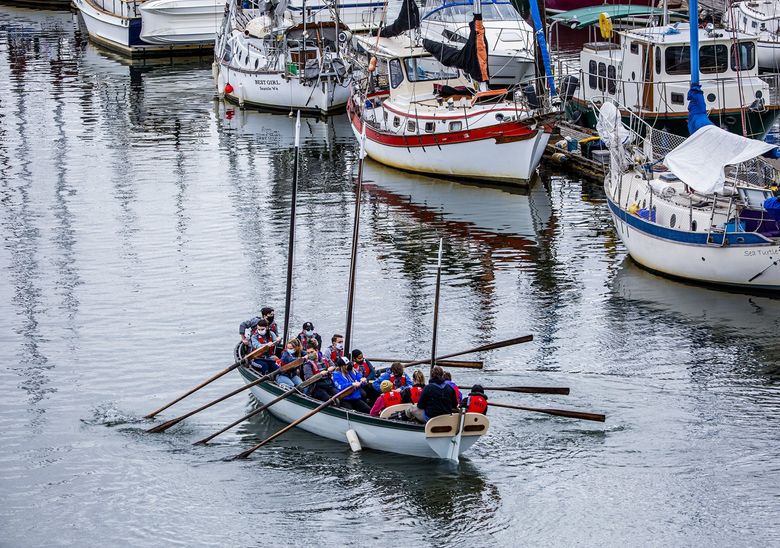
Students at Maritime High School row a boat on the Duwamish Waterway in Seattle. (Daniel Kim / The Seattle Times, 2021)
The school’s low enrollment was just what Jacqueline Lomeli Chavez was seeking for her son, Evan, 17, a junior who’s learning maritime shipyard welding.
The school’s staff was welcoming and ensured he stayed on top of his work, she said.
Evan liked the nontraditional setting and especially appreciated the hands-on approach to learning the scope of the industry.
“It gives you a lot more opportunities to explore what you want to do,” he said.
Plus, the welding program is already part of South Seattle College, so Evan can go right to work after graduation without worrying about tuition, he said.
“He knows that when he graduates, if he does not want to go to college, at least he has a skill that’s very well-paid,” said Lomeli Chavez, who works for the district.
Gordon, Maritime’s principal, said she’s addressed issues when they’ve come to her attention and acknowledged that building a new school often requires pivots.
“Not everybody is going to be happy with some of these shifts,” Gordon said. “My focus is always what’s best for students, what’s sustainable. And students are having a really great experience.”
She’s planning for more dual-credit classes next year. This month, the school debuted a quarterly forum for families and school leaders to discuss school-related changes, courses and performance — what families and students have been seeking.
Denisa R. Superville: 206-464-8216 or dsuperville@seattletimes.com. Denisa R. Superville is an Education Lab reporter at The Seattle Times, where she writes about school districts as they emerge from the pandemic years.