


Dawn illuminates the city of Yakima last month. (Erika Schultz / The Seattle Times)
Seattle Times columnist
The ongoing government shutdown has begun impacting federal food assistance for millions of Americans. In Washington, hundreds of thousands of people did not receive their SNAP benefits on Nov. 1.
The disruption to SNAP, the Supplemental Nutrition Assistance Program, is already having consequences across Washington state. And that’s particularly true in rural and economically struggling counties where reliance on food assistance is highest.
According to March 2025 data from the Washington Department of Social and Health Services, the most recent county-level data available, more than 930,000 residents statewide received SNAP benefits, roughly 12% of the state’s population.
More than half of Washington residents receiving food stamps are in families with children. More than a third are in households with older adults or people with disabilities, and more than a third are in working families.
Related
SNAP FAQ: WA, Seattle officials’ response, where to get food aid and more
But there are wide disparities between counties in the share of residents who receive these benefits.
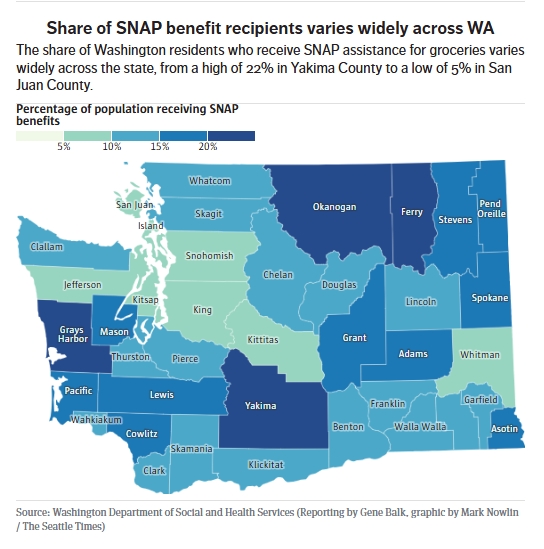
Of the state’s 39 counties, Yakima was the most dependent on SNAP benefits. About 22% of Yakima County residents — more than 57,000 people — relied on SNAP to help pay for food. Neighboring Ferry and Okanogan counties showed similarly high reliance, with about 21% of residents enrolled in the program. Grays Harbor and Pend Oreille counties rounded out the top 5, both at about 20%.
Share of SNAP benefit recipients varies widely across WA
The share of Washington residents who receive SNAP assistance for groceries varies widely across the state, from a high of 22% in Yakima County to a low of 5% in San Juan County.
Source: Washington Department of Social and Health Services (Reporting by Gene Balk, graphic by Mark Nowlin / The Seattle Times)
In contrast, some more affluent counties mostly in the Puget Sound region had SNAP participation rates well below 10%. The lowest rate of SNAP participation was in San Juan County, at around 5%, followed by Island County at 7% and Whitman County at 8%. King County had the fourth-lowest rate at just over 8%, and Snohomish County was fifth at 8.5%.
The federally funded program is administered by individual states, which distribute the food assistance to eligible residents.
More about SNAP benefits
- Families on SNAP worry about not just feeding themselves but also their pets
- Supreme Court issues emergency order to block full SNAP food aid payments
- Judge orders full funding of SNAP benefits
- Where to get food in King, Snohomish, Pierce counties as SNAP lapses
- In Seattle, neighbors rush to fill the SNAP gap
- How Seattleites can help people losing their SNAP benefits
Yakima and other Washington counties with high SNAP participation have largely agricultural economies, where seasonal and low-wage work are common. The missed SNAP benefits are already resulting in an increase in demand at local food banks, straining already limited community resources.
Urban areas are also feeling the pinch. While King County has a relatively low SNAP participation rate, in terms of the number of people, it’s the highest in the state. Nearly 200,000 county residents rely on SNAP benefits, and cutting those payments could ripple through local economies, reducing spending in grocery stores and small businesses that depend on SNAP purchases.
The Trump administration said Monday it would provide partial funding for SNAP in November, after two judges issued rulings that ordered the government to continue operating the program. The plan would require using money from the U.S. Department of Agriculture’s contingency fund to make the reduced payments.
But on Thursday, a federal judge ordered the Trump administration to fully fund SNAP benefits for November.
The contingency fund that would be used to make partial payments in the plan announced Monday holds about $4.65 billion — roughly half of the $8 billion typically needed each month to cover SNAP benefits nationwide. To adhere to the ruling and fully fund SNAP, the administration would have to find additional sources. The Trump administration promptly appealed Thursday’s decision.